Introduction
Passwords are the weakest link in financial security. Biometric authentication is replacing them because it solves three massive problems - fraud, compliance, and user drop-off. For fintechs, switching to biometrics is about speed since biometric eKYC cuts onboarding time from days to minutes. It helps companies meet strict DPDP rules and RBI mandates. Hardware plays a big role here. You need certified scanners to make this work. Companies like Mantra Softech build the devices that secure these transactions at the source. This article breaks down the ROI, the regulations, and why your next POS transaction depends on biological identity.
The End of the Password Era in Fintech
The FIDO Alliance and tech giants like Apple have recently signalled a massive shift in global security standards. They are moving away from typed credentials entirely. This global phenomenon confirms what security experts have known for years. The model of protecting money with a string of characters is broken.
Financial systems used to rely on something you know, like a password, to protect something you have, like a debit card. That logic falls apart today. Credential stuffing and social engineering attacks have made static passwords easy targets.
Fintech product managers deal with a difficult trade-off called the security friction paradox. If you make the security too tight with long passwords or complex resets, customers leave. If you make it too loose, fraud increases. Biometrics fix this problem. They verify identity based on who the user is. This offers high security without forcing the user to remember complex codes.
Industry Benchmarks - Why Fintechs Are Switching to Biometrics
Biometric systems are winning against password models across the global and Indian markets. The data is clear.
Industry models show three main benefits.
First is fraud reduction. Automated bots cannot fake a live fingerprint or face scan. Multi factor authentication that uses biometrics blocks replay attacks effectively.
Second is higher conversion. When users can log in with a touch or a glance, they finish the transaction. Completion rates are 25 to 30 percent higher compared to OTP flows.
Third is lower support costs. Resetting passwords is expensive for banks. Biometric logins remove that cost almost entirely.
For a platform handling high volumes, a 1 percent bump in transaction success translates to significant revenue.
Biometric eKYC - The Engine Behind Digital Banking and Lending
Speed is the main factor in acquiring new customers for digital banking. Old KYC processes involved uploading documents and waiting for manual checks. This slow process often causes a 35 to 40 percent drop in users.
Biometric eKYC changes the math. It combines liveness detection with instant database matching.
This enables verification in minutes rather than days. It provides proof that the person is actually present, which stops mule accounts. It also allows for paperless onboarding which is much cheaper.
Model Comparison - Manual KYC vs Biometric eKYC (Per 1 Million Users)
| Metric | Manual or OTP Only KYC | Biometric eKYC |
|---|---|---|
| Onboarding time | 24 to 72 hours | Under 5 minutes |
| Identity fraud rate | 1 to 1.5 percent | 0.2 to 0.3 percent |
| Cost per onboarding | 120 to 150 INR | 25 to 40 INR |
| Drop off rate | 35 to 40 percent | 10 to 15 percent |
For product teams, biometric eKYC is a growth tool. It lowers the cost of acquiring a customer and speeds up loan disbursals.
Biometric POS and MicroATM Terminals vs Traditional PIN
PIN based security has flaws in physical settings like POS terminals and MicroATMs. This is true in rural or semi urban areas where assisted banking is common. A PIN can be watched, shared, or forced out of someone.
Biometric POS terminals solve this by authenticating the person instead of the card.
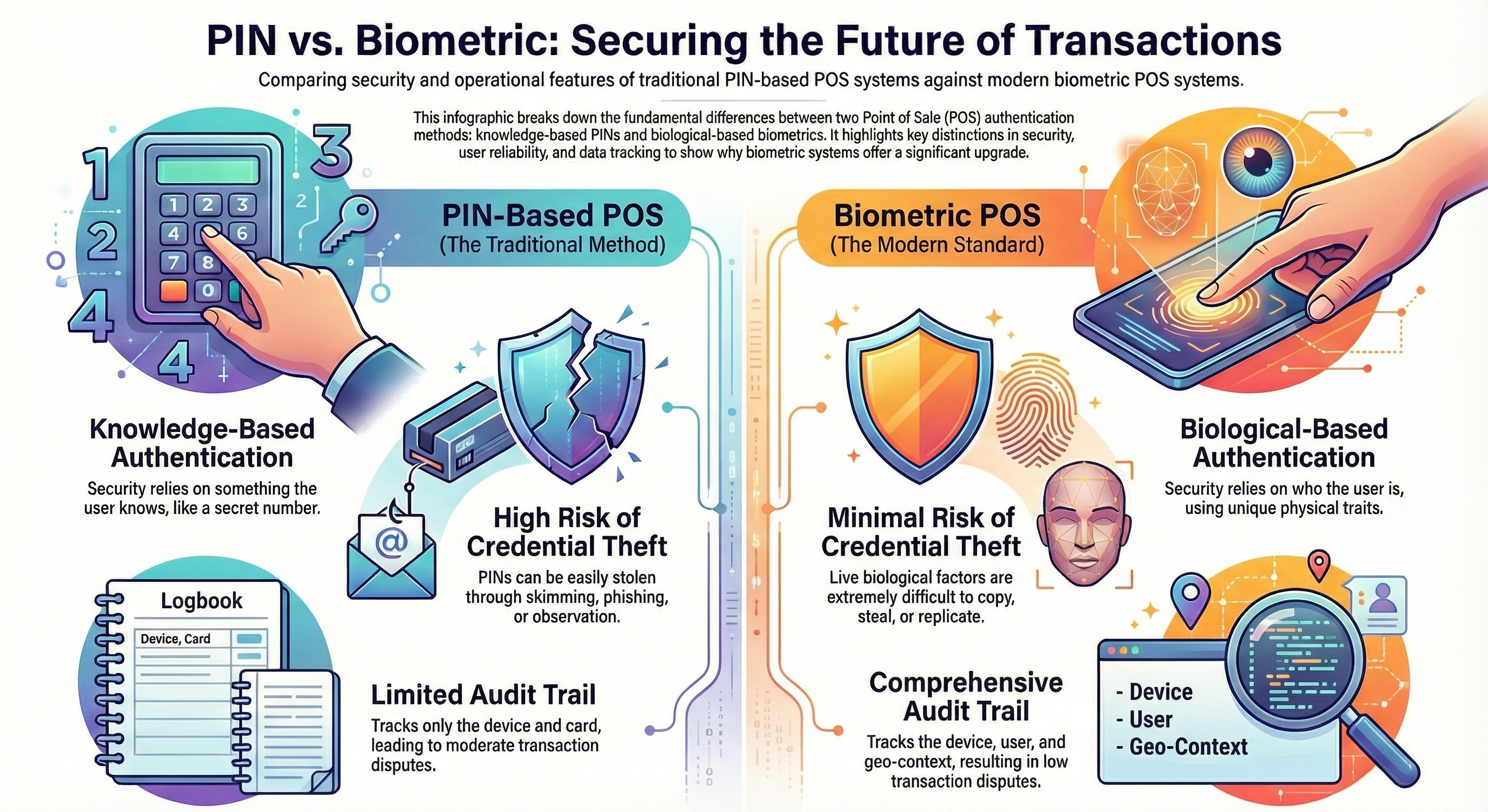
For last mile banking, a biometric POS transaction creates higher trust. It results in fewer disputes and brings more people into the financial system.
Regulatory & Compliance Landscape
Fintech authentication operates under strict rules.
In India, the RBI mandates an Additional Factor of Authentication. Biometrics fit this requirement perfectly when they are secure.
The UIDAI requires the use of L1 certified biometric devices. These scanners perform encryption and signing inside the hardware itself.
The DPDP Act 2023 classifies biometric data as sensitive. This means companies must get clear consent and process the data securely.
A compliant setup ensures encryption happens at the source. It ensures raw images are never stored. It requires certified hardware and a clear way for users to give consent.
Uptime, Fraud Reduction, and Fintech ROI
Downtime in authentication kills transaction volume.
A conservative model shows that friction from PINs or OTPs causes 2 to 3 percent of users to abandon the transaction. Well maintained biometric systems keep failure rates below 0.5 percent.
For platforms processing thousands of transactions a day, this gap matters. It leads to more successful transactions and less strain on customer support. Over a year, biometric authentication can boost success rates by 1.5 to 2 percent. That is a massive margin in fintech.
The Future - Multimodal and Adaptive Authentication
Security is moving toward using multiple types of biometrics at once.
Systems now combine face scans for quick access with fingerprints for high value actions. Voice is used for call centre flows. Behavioural signals help assess risk in the background.
The strength of the check will change based on the risk. A small transfer might just need a face scan. A large transfer might need a fingerprint too. This maximizes security without annoying the user.
Why Secure Terminals Matter
Authentication is only as good as the device capturing it. You cannot have secure software on insecure hardware.
This is where the physical layer becomes critical. Leading manufacturers like Mantra Softech solve this by building L1 certified terminals. These devices ensure that biometric data is encrypted the moment it hits the sensor.
By integrating Mantra Softech scanners, fintech platforms can scale their operations across POS and MicroATM environments while staying fully compliant with UIDAI and RBI standards. The hardware handles the heavy lifting of security so the application can focus on the user.
Conclusion
Trust is the actual product in fintech. Passwords and PINs cannot provide the security or experience needed anymore. Biometric authentication offers strong security that aligns with regulations and makes life easier for the user.
Biometrics are now the baseline for modern services. They enable instant account opening and secure cash withdrawals. The question for leaders is not if they should use biometrics. It is how deeply they can integrate them to secure the entire transaction lifecycle.
Comments