Introduction
Effective biometric device lifecycle management cuts total cost of ownership by up to 35 percent. Most organizations fail because they focus on sensor accuracy instead of the long-term rhythm of device health. Managing these assets requires an inestimable amount of attention to the device lifecycle to avoid the rhythm of constant, unplanned outages. Using a dedicated platform like SERVICO by Mantra Softech allows organizations to manage these complexities from a single interface. This approach ensures that every biometric device remains an asset rather than a liability.
Why Lifecycle Management Matters More Than Biometric Accuracy
Most procurement discussions centre on sensor resolution or how fast a person can be authenticated. While these technical specs are important, they do not determine the long-term success of a large-scale deployment. In environments like high security banks or massive manufacturing plants, the ability of the system to stay online is the true measure of value.
A biometric device is a long-term infrastructure asset. When the lifecycle is ignored, the result is a resonance of rising costs and frequent downtime. Organizations that avouch for a structured management strategy find they can predict their budgets with much higher accuracy. They move away from a reactive state where every broken device is a minor crisis. Instead, they treat the fleet as a managed ecosystem where health is monitored and maintained.
The True Total Cost of Ownership (TCO) of Biometric Fleets
The invoice price of a biometric device typically represents less than half of its true cost over five years. A perusal of global deployment data shows that hidden expenses often overwhelm the original budget.
The total cost includes procurement and deployment and maintenance and downtime and logistics. Maintenance is a significant factor. This includes firmware updates and spares and the recurring rhythm of Registered Device security renewals. These security protocols require annual or multiyear certifications to ensure the device can communicate securely with central servers. If these renewals are missed, the device becomes a paperweight regardless of its physical condition.
Example: 1,000-Device Biometric Deployment (5 Years)
| Cost Component | Typical Contribution |
|---|---|
| Hardware procurement | 35–45% |
| Maintenance & spares | 18–22% |
| Downtime & productivity loss | 12–15% |
| RMA logistics & admin | 8–12% |
| Unplanned replacements | 8–10% |
A typical five-year cost breakdown for a thousand device fleet from the above table shows that hardware is only about 40 percent of the spend. Maintenance and spares take up about 20 percent. Productivity loss from downtime contributes another 15 percent. Logistics for repairs and unplanned replacements fill the remaining gap.
Why Uptime Is the Real ROI Driver
Uptime is a business metric that directly impacts the bottom line. In biometric environments, a small percentage gain in availability translates to thousands of hours of recovered productivity.
Research into biometric deployments shows that reactive models usually top out at 98 percent uptime. This sounds high but for a thousand device fleet it means over seven thousand hours of lost time every year. Moving to a predictive model can push this number to 99.5 percent or higher. This reduces the disruption by 75 percent without needing to buy a single extra device. The gains come entirely from better management of the existing fleet.
Managed vs Unmanaged Fleet - A Cost Model
When comparing a managed fleet to an unmanaged one, the financial contrast is clear. In a three year model of five hundred devices, an unmanaged fleet often sees a failure rate of 15 percent annually. This leads to high reactive costs and significant administrative overhead.
A managed lifecycle approach can drop that failure rate to 5 percent. The total cost over three years for an unmanaged fleet might reach 3,200,000 while a managed fleet stays around 2,400,000. This represents a 25 percent saving. These funds are effectively recovered by simply avoiding the chaos of constant hardware failure.
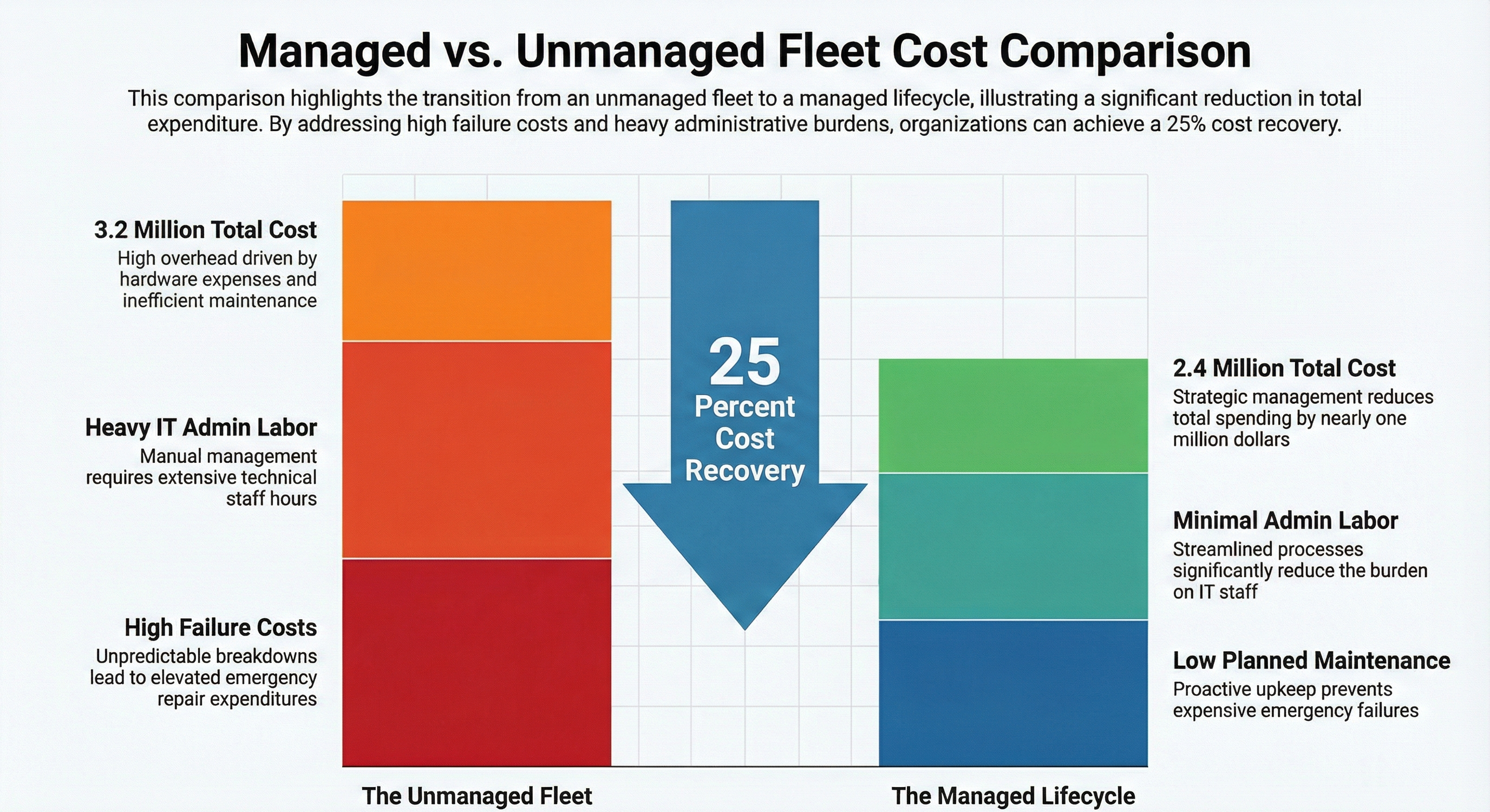
Without a managed lifecycle, these sophisticated assets can quickly transition from critical security tools into unpredictable liabilities, as the true cost of ownership is often hidden in the years following the initial purchase.
Predictive Maintenance - Moving from Repair to Prevention
Most biometric failures give warning signs before they happen. There might be a slow increase in how long it takes to authenticate a user. False rejection rates might start to creep up. Power signals might become unstable.
Predictive maintenance uses telemetry to catch these signs early. Instead of waiting for a worker to report a broken scanner, the system alerts the team to clean the sensor or update the firmware during a planned window.
Organisations using predictive servicing typically achieve:
30–40% reduction in emergency service calls
20–25% lower spare inventory costs
35% faster issue resolution
More importantly, device lifespan is often extended by 12–18 months, directly reducing replacement CAPEX.
KPI Driven Uptime Management
The best organizations run their biometric fleets using specific metrics. The most effective KPIs include:
Device availability percentage
Mean Time Between Failures (MTBF)
Mean Time To Repair (MTTR)
Annualised failure rate
License and warranty compliance
For example, reducing MTTR from 5 days to 2 days across a large fleet significantly improves uptime and user experience while lowering support costs.
If it takes five days to get a device back online, the productivity loss is massive. Reducing that window to two days through better logistics and structured workflows drastically improves the user experience. Keeping a close eye on license and warranty compliance ensures that no device falls out of service because of a forgotten paperwork deadline.
Why Integrated Lifecycle Platforms Deliver Higher ROI
Optimization is difficult when data is scattered across different spreadsheets and vendors. A centralized platform like SERVICO by Mantra Softech provides a single view of every device in the fleet.
These systems offer automated warranty tracking and real time repair updates. They also provide failure trend analysis. If one specific location has a high failure rate, the data might show it is due to environmental factors like dust or power surges. Addressing the root cause saves more money than simply shipping a replacement. Users of integrated platforms typically see a 30 percent reduction in the cost of processing repairs.
Replacement Planning - The Final Cost Lever
Unplanned replacements are a major reason why budgets spin out of control. Without data, devices are often replaced too late or even too early.
Data led planning allows a company to stagger its capital expenditure. They can replace high risk units first and keep stable devices in the field for an extra year or two. This can extend the average lifespan of a fleet by 12 to 18 months. Over a five-year period, this reduces the money spent on new hardware by nearly 20 percent.
Conclusion
Biometric devices are not simple peripherals that can be installed and forgotten. They are the gateways to security and productivity for an entire organization. Adopting a structured approach to biometric device lifecycle management is the most effective way to protect that investment. For CTOs, security architects, and operations leaders evaluating large biometric deployments, lifecycle strategy is no longer optional. It is the single most important factor in transforming biometric investments from recurring cost centres into high-availability infrastructure assets.
For more information on hardware standards you can view the Mantra L1 scanner product and service page.
Comments