Introduction
Trust is the new currency of the digital economy. As facial recognition and fingerprint scanning become standard for everything from banking to employee access, the technology has outpaced the rules governing it. Biometric identity governance is the framework that catches up. It ensures that the systems verifying who we are do not accidentally exclude us or expose our most personal data.
This article explores how to manage ethical risks like demographic bias, the importance of continuous performance audits using diverse datasets, and the specific legal obligations for high-volume data handlers under India’s DPDP Act. You will also find practical steps for inclusive design and a breakdown of how hardware choices impact compliance.
Why Biometric Identity Governance Matters Now
Biometric authentication has moved from niche security applications to the core of digital identity systems. It is used in banking, government services, access control, healthcare, and public infrastructure. As adoption scales, the focus can no longer remain limited to accuracy or speed alone.
Biometric systems directly interact with human identity. Errors, bias, or misuse can exclude users, compromise privacy, or erode public trust. This makes biometric identity governance a responsibility that goes beyond the IT department. It is a boardroom issue.
Governance in biometrics ensures that systems are ethical in how identity data is collected, fair across demographic and physical diversity, and transparent in consent and accountability.
Understanding Ethics and Bias in Biometric Systems
Biometric bias occurs when a system performs unevenly across different population groups. This often stems from how the artificial intelligence models are trained. If a facial recognition algorithm is trained primarily on images of lighter-skinned men, it will struggle to accurately identify women or people with darker skin tones.
Research from the essential "Gender Shades" project by MIT researchers highlighted how commercial algorithms had error rates of up to 34% for darker-skinned women while remaining nearly perfect for lighter-skinned men. Similarly, NIST (National Institute of Standards and Technology) reports have historically found higher false positive rates for Asian and African American faces in certain algorithms.
Ethical biometric systems aim to minimize these disparities by design. This involves training models on diverse datasets that reflect the actual user base and testing across age, gender, ethnicity, and physical conditions. Ethics in biometrics is not about eliminating all risk, which is unrealistic, but about recognizing, measuring, and mitigating bias transparently.
Reducing Biometric Error in Diverse Populations
Performance variation is one of the most important yet under discussed challenges in biometric deployments. Environmental factors such as lighting, sensor wear, or physical labour can disproportionately affect certain user groups. For example, a biometric attendance machine in a factory may struggle to read the fingerprints of manual labourers whose hands have worn ridges.
To reduce biometric error, organizations need to move beyond standard accuracy checks. This requires continuous bias audits. A proper audit involves testing the live algorithm against a "Golden Set" - a curated dataset of diverse faces or fingerprints that have been manually verified. By running the system against this set regularly, you can detect if an update has introduced new errors for specific demographics.
Governance frameworks treat performance monitoring as an ongoing responsibility. This includes tracking False Rejection Rates (FRR) and False Acceptance Rates (FAR) by demographic segments and calibrating devices for local environmental conditions.
Inclusive Biometric Authentication and Accessibility
Inclusive biometric authentication ensures that systems work for everyone, including individuals with disabilities or physical limitations. A rigid system that demands a user hold perfectly still or look directly at a camera at a specific height will inevitably fail for users in wheelchairs or those with tremors.
Common inclusion challenges include fingerprint wear among manual labourers, facial recognition limitations for users with facial differences, and accessibility barriers for elderly or visually impaired users.
Inclusive design addresses these challenges by offering alternative modalities. If an employee biometric attendance system fails for a user with worn fingerprints, the system should seamlessly offer a facial scan or a smart card backup without forcing the user to ask for help. Adjustable capture thresholds and clear user guidance are also vital. Accessible biometrics are not weaker biometrics. When designed correctly, they increase system reliability and user trust.
Biometric Privacy and Consent by Design
Biometric data is irreversible. Unlike passwords, biometric traits cannot be changed once compromised. This makes privacy protection central to ethical biometric governance.
Best practices for biometric privacy include encryption at the point of capture and storage of encrypted templates rather than raw images. This means the system stores a mathematical representation of the face or finger, not the photo itself. Strict access control, audit logging, and purpose limitation are also non-negotiable.
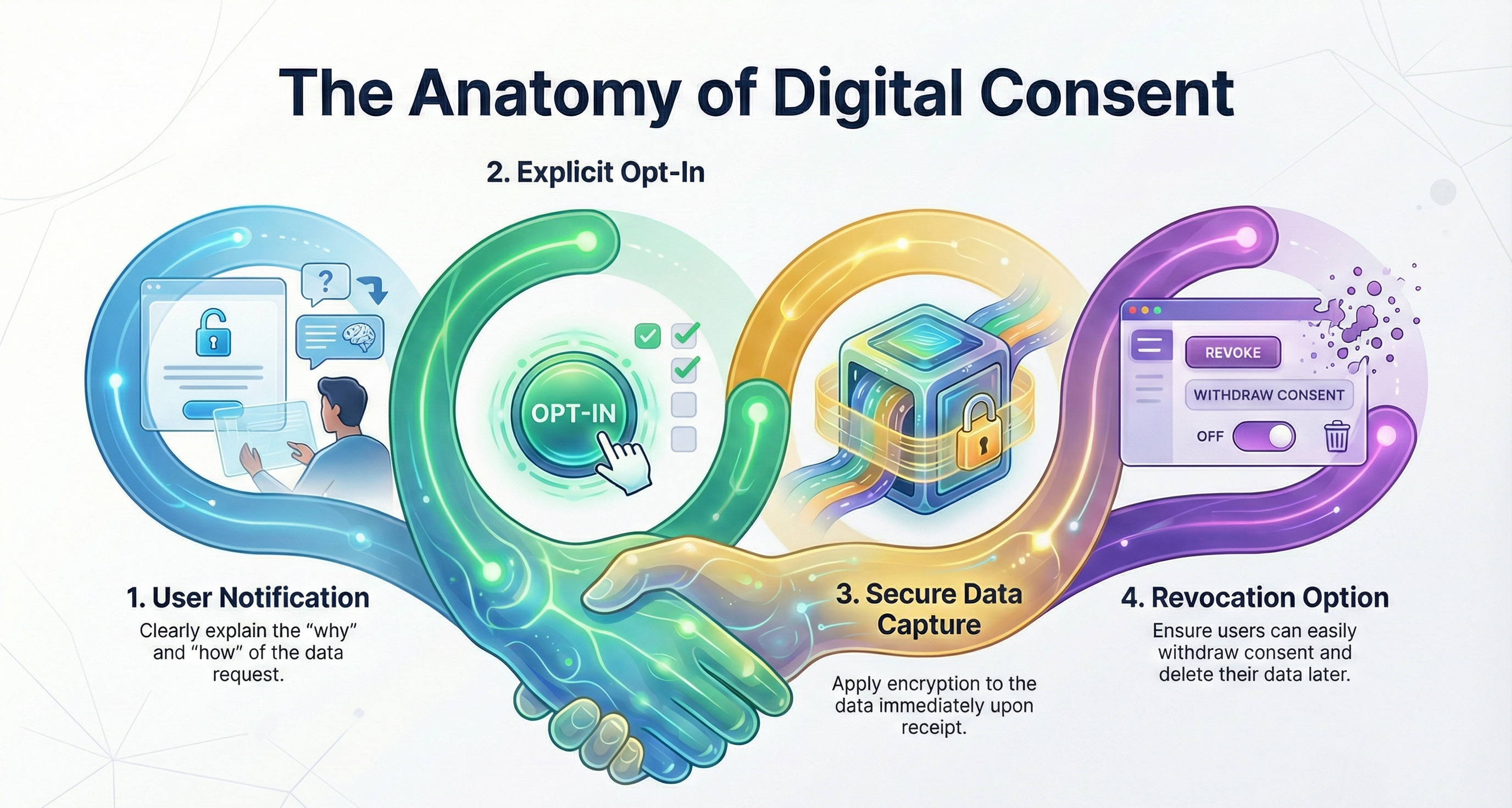
Consent must be explicit, informed, and revocable. Users should clearly understand why their biometric data is collected, how it is used, and how long it is retained.
India’s Regulatory Context for Biometric Data
India has one of the world’s most mature biometric ecosystems, which places a higher responsibility on governance.
Protection of biometric data under India’s Digital Personal Data Protection (DPDP) Act is now a legal mandate. The Act classifies biometric data as sensitive, requiring stricter handling protocols.
For large enterprises, especially those classified as "Significant Data Fiduciaries" (SDFs), the obligations are extensive. These organizations must appoint a Data Protection Officer (DPO) based in India, conduct periodic Data Protection Impact Assessments (DPIA), and undergo independent data audits. The DPIA is particularly important for biometric systems as it forces the organization to map out potential risks to user rights before the technology is even deployed.
Ethical Biometric Systems in Practice
Ethical biometric deployment is not a single control but a lifecycle approach. Governance must cover design, procurement, deployment, and incident response.
The choice of hardware plays a significant role here. A secure biometric system relies on trustworthy sensors that do not store data locally in unencrypted formats. Hardware providers like Mantra Softech align with these governance goals by ensuring their devices meet certifications like STQC (Standardisation Testing and Quality Certification), which validates that the sensor hardware meets specific quality and security benchmarks required by government and enterprise projects. Using certified devices reduces the risk of hardware level tampering and ensures the raw biometric data is handled correctly before it even reaches the software layer.
Transparency, Trust, and Public Confidence
Public trust is fragile in identity systems. A lack of transparency can quickly undermine adoption, even when systems are technically sound.
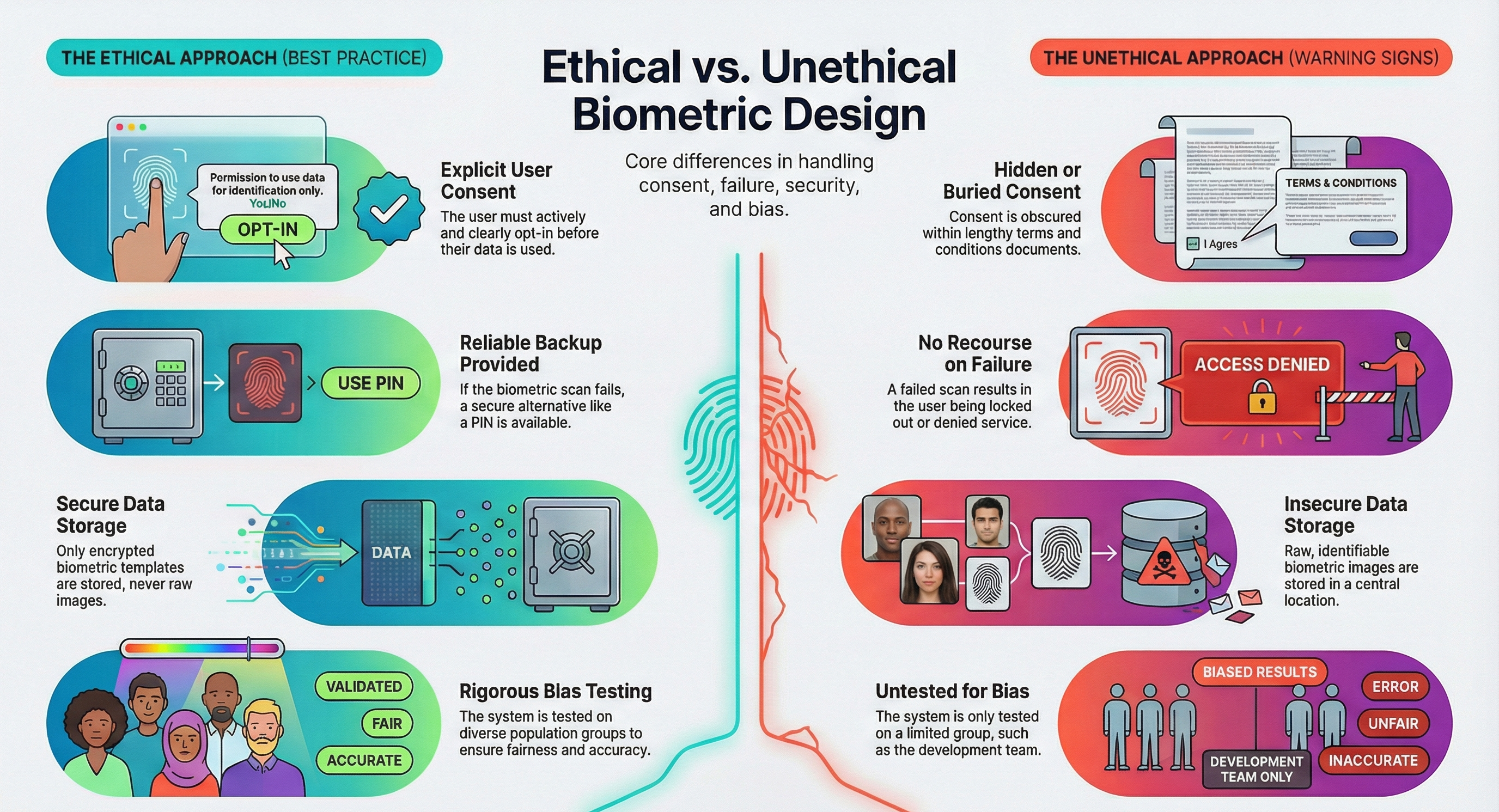
High trust biometric systems publish clear data usage policies and communicate performance limitations honestly. They provide escalation paths for user grievances and allow independent audits. Transparency is not a risk but a trust accelerator.
The Future of Biometric Identity Governance
As biometric systems evolve, governance frameworks must evolve with them. Future ready governance will focus on continuous bias audits using real world data and adaptive authentication that adjusts to risk context.
There will also be stronger alignment between AI ethics and identity regulation. As "deepfakes" become more common, the governance of liveness detection (proving a face is real and not a video) will become just as important as the matching algorithm itself. Biometric identity governance will increasingly define not just how systems work, but whether they are accepted.
Conclusion
Biometric systems are powerful tools, but power without governance creates risk. Ethics, fairness, and inclusivity must be treated as core design requirements, not post deployment fixes.
Organizations that invest in ethical biometric identity governance protect users, reduce regulatory risk, and build long term trust. In a world where identity is digital, responsible design is the strongest form of security.
Comments