Introduction
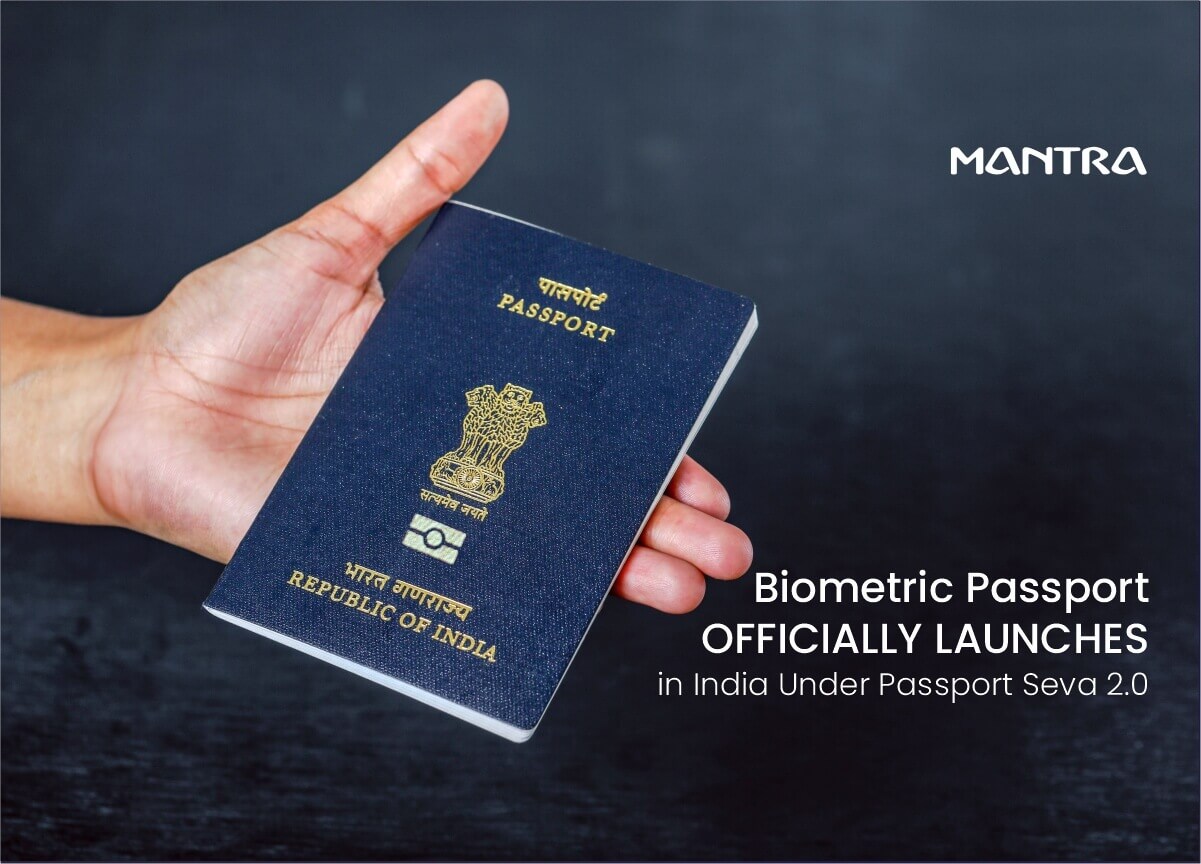
India has officially rolled out biometric passports, also known as e-passports, across the country under Passport Seva Program 2.0. The initiative represents a major upgrade to India’s passport system, combining physical identity verification with digital security features.
The nationwide launch was announced by External Affairs Minister Dr. S. Jaishankar on June 24, 2025, during the 13th Passport Seva Divas. By November 2025, more than 80,000 e-passports had already been issued through pilot projects, and full-scale issuance has now begun in all major Passport Seva Kendras (PSKs) and Post Office Passport Seva Kendras (POPSKs).
India’s Gradual Implementation
Malaysia was the first to issue electronic passports in March 1998, but Belgium was the first to issue ICAO-compliant biometric passports in 2004. Germany and Norway followed in 2005. The United States, ever the reluctant adopter of anything not invented in Silicon Valley, rolled out its version in 2006.
Today, over 140 countries issue e-passports. More than a billion are in circulation globally.
India began exploring biometric passports in 2008, when the first e-passport was issued to then-President Pratibha Patil. For several years, the technology remained limited to diplomatic and official passports. Progress slowed due to challenges in chip procurement, encryption compliance, and tender approvals. Testing resumed in 2024 at Regional Passport Offices (RPOs) in Nagpur and Bhubaneswar under Passport Seva Program 2.0.
Following successful trials, the Ministry of External Affairs approved a nationwide rollout in August 2025. The system is now live in 13 major cities including Delhi, Chennai, Hyderabad, Surat, Goa, Jammu, Shimla, Raipur, Amritsar, Jaipur, Ranchi, Nagpur, and Bhubaneswar. Indian missions abroad, starting with the Embassy of India in Abu Dhabi, have also begun issuing biometric passports under the Global Passport Seva Program (GPSP 2.0).
What is a Biometric Passport?
Definition: A biometric passport is a machine-readable travel document embedded with a contactless RFID (Radio Frequency Identification) chip that securely stores a traveler’s personal and biometric data.It is also known as an e-passport.
Here's what's inside that chip:
Facial recognition data: A digital image (usually JPEG or JPEG 2000 format) of your face, captured with enough resolution to map bone structure, eye distance, and facial ratios.
Digital signature: A cryptographic seal that confirms authenticity with the right keys.
Iris scans: A biometric backup, just in case your fingerprints fail (say, from years of manual labor or chemical exposure).
Fingerprints: In India's case, scans from all ten fingers.
The chip has 64 kilobytes of storage and communicates via the ISO/IEC 14443 international standard, the same protocol used in contactless credit cards and metro smart cards. The technology holds the same kind of encryption and authentication that protects your online banking.
Moreover, Public Key Infrastructure (PKI) ensures that the data on the chip is nearly impossible to forge, when all security mechanisms are "fully and correctly implemented."
The Security Architecture of Biometric Passport
To protect sensitive biometric and personal data, the Indian e-passport employs multiple cryptographic and access-control mechanisms.
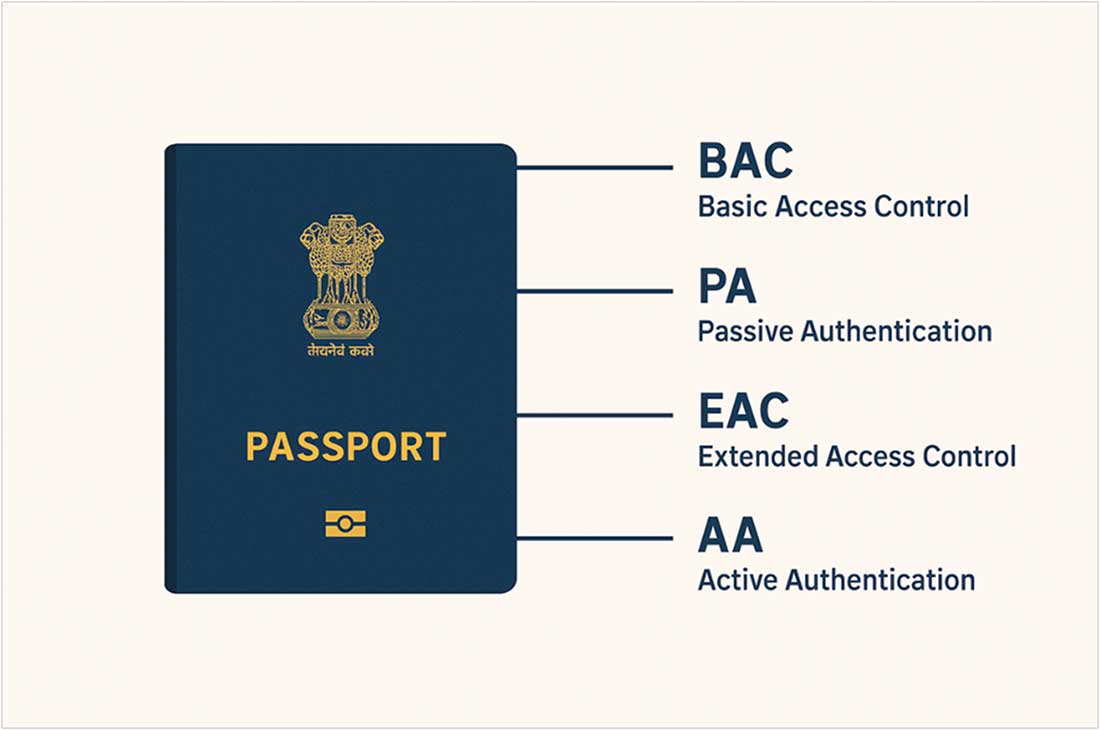
Each layer protects the biometric and personal data stored in the chip from unauthorised access or cloning.
-
Basic Access Control (BAC):
BAC encrypts the communication between the passport chip and the reader. The reader must supply a digital key derived from the Machine-Readable Zone (MRZ) – which includes the document number, date of birth, and expiry date – before data can be accessed.
-
Passive Authentication (PA):
PA verifies the authenticity of data stored on the chip. Hash values of each data file (such as the photograph or fingerprints) are compared with a digital signature. If even a single file is modified, the verification fails.
-
Extended Access Control (EAC):
EAC adds mutual authentication, meaning both the passport chip and the reader must prove legitimacy to each other before sensitive data such as fingerprints or iris scans are accessed. This prevents unauthorised or foreign devices from reading biometric information.
-
Faraday Cage Shielding:
While some countries use Faraday cage shielding within the passport cover to block external RFID signals, India’s current biometric passport version does not include this feature. However, users can opt for RFID-blocking sleeves or covers for added protection.
-
Active Authentication (AA):
AA prevents chip cloning. It confirms that the chip contains a unique private key that cannot be duplicated or extracted.
Timeline of India’s Biometric Passport Rollout
| Year | Key Milestone |
|---|---|
| 1998 | Malaysia issues the world’s first e-passport. |
| 2003 | ICAO releases Doc 9303, setting international standards for biometric passports. |
| 2004 | Belgium issues the first ICAO-compliant biometric passport. |
| 2008 | India introduces biometric passports for diplomatic use. |
| 2023 | Development accelerates under Passport Seva 2.0 with pilot testing plans. |
| 2024 | Pilot testing in Nagpur and Bhubaneswar; 80,000 e-passports issued. |
| 2025 | Nationwide rollout begins in 13 cities; GPSP 2.0 starts for Indian missions abroad. |
How to Apply for an E-Passport?
Applying for a biometric passport follows the same process as a standard passport, with the addition of biometric enrollment.
Step :
Online Application
Visit the official Passport Seva portal. Create an account, fill out the application form, and select the relevant passport type.
Step :
Pay Fees and Schedule an Appointment
The fee structure remains unchanged:
₹1,500 for a 36-page passport for adults.
Reduced fee for minors (below 15 years).
Choose a Passport Seva Kendra (PSK) or Post Office Passport Seva Kendra (POPSK) near you and schedule your appointment.
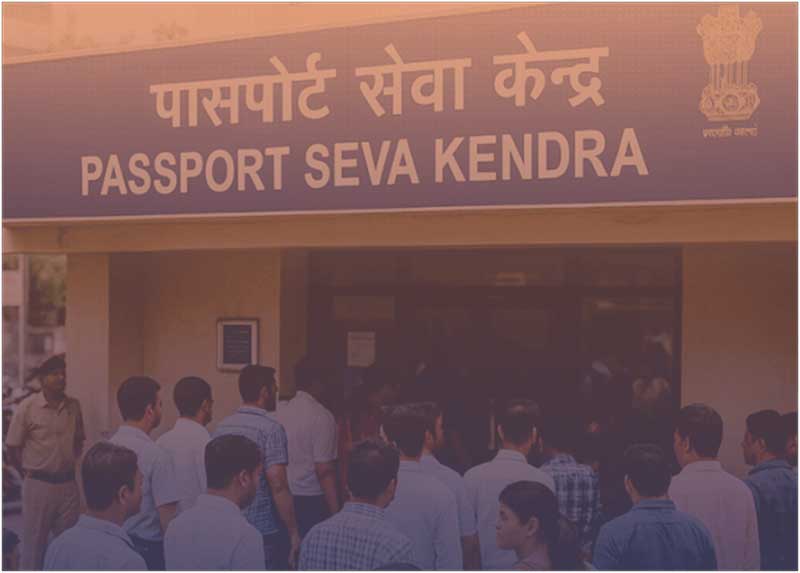
You can easily find your nearest Passport Seva Kendra by visiting passportindia.gov.in
Step :
Biometric Enrollment at PSK
During your appointment:
Your photograph is taken using a high-resolution camera.
All ten fingerprints are scanned.
Both irises are captured using an iris scanner.
The data is encrypted and written onto the passport’s chip at the India Security Press, Nashik, which handles all e-passport personalization and printing.
Step :
Submit Documents
You’ll need:
Proof of identity: Aadhaar, PAN, Voter ID, or Driving License
Proof of address: Utility bill, Aadhaar, or bank statement
Proof of birth: Birth certificate, school certificate, or Aadhaar
Existing passport (if applying for renewal)
Step :
Police Verification
The mPassport Police App has modernised the verification process. In most states, this step now takes 5–7 days, reducing processing times significantly.
Step :
Passport Delivery
After verification, your biometric passport is printed and dispatched via India Post’s Speed Post service. Delivery typically takes 7–10 working days. Existing passports remain valid until expiry and can be used for travel until replaced.
Final Thoughts
India’s biometric passport initiative marks the beginning of a new era in secure and efficient international travel. With embedded biometrics, cryptographic safeguards, and centralized digital management under Passport Seva 2.0, the country now joins a global network of ICAO-compliant states using e-passports to strengthen identity assurance and border control
As the rollout expands across all Passport Seva Kendras and Indian missions abroad, the biometric passport will become the default travel credential for Indian citizens — combining national security, data integrity, and convenience in a single document.
FAQs
No. Existing passports remain valid until their expiry date. You can continue using your regular passport. However, new applicants and renewals will default to e-passports unless explicitly requested otherwise (and even that option may phase out).
At airports equipped with e-gates (like Delhi, Mumbai, and Bengaluru), yes. You scan your passport, look into a camera for facial recognition, and proceed – no officer interaction needed. At airports without e-gates (most smaller Indian airports, and many international ones), the process is identical to a regular passport.
Report it immediately to the nearest police station and Passport Seva Kendra. You'll need to apply for a new passport (with fresh biometric enrollment). The lost passport will be invalidated, but the biometric data associated with it remains on record.
In theory, RFID chips can be read from a short distance (a few centimeters to a meter, depending on the reader's power). Basic Access Control (BAC) requires the reader to know your passport's MRZ data (date of birth, expiry, document number) before accessing the chip. Without BAC, however, the chip could leak metadata (like which country issued it).
Your old passport is returned to you with "cancelled" stamped on it. Any valid visas in the old passport remain usable – you'll just need to carry both passports when traveling to those countries.