Introduction
The integration of RFID asset tracking with a biometric authentication system creates a secure ecosystem for defence logistics that moves beyond simple inventory management. This approach allows defence organisations to secure armouries and track critical assets while enforcing zero-trust access across an Indian military base or global depot. The combination provides real-time visibility in defence logistics to establish accountability and mission-ready security in high-risk environments. It solves the issue of lost keys and shared passwords by using biometric access control for defence purposes ensuring that the person handling the weapon is authorized to do so.
The Defence Logistics and the Emerging Security Challenge
Modern defence logistics represents far more than the simple movement of supplies from point A to point B. It acts as the definitive measure of securing weapons and ammunition alongside vehicles and mission-critical equipment. These assets are often housed in bases and secure installations situated in remote or high-risk geographical areas. Every access point and every asset movement carry direct security connotations that can impact national safety.
The current transparency of asset utilisation remains fragmented in most defence setups. Isolated access control IoT devices often fail to communicate with central registers. Reliance on manual logbooks and delayed reporting creates an environment where data is often an upcast of estimates rather than confirmed facts. This inability to create definite accountability is a significant operational gap. Reconstructing access histories becomes inaccurate when audits or investigations are inevitable.
These gaps are operationally dangerous as defence forces modernize. Conventional systems struggle to answer basic questions regarding who accessed an asset and when it was issued. There is often no digital proof to confirm if the action was authorized. This lack of data can unintentionally denigrate the integrity of a secure facility. If a commander cannot see the chain of custody in real time, then the security of the installation is theoretical rather than actual.
Why Traditional Access Control Falls Short
Conventional access control methods were not engineered for the complexity or the stakes of modern defence operations. In military environments the risk of insider threats or unauthorized access carries consequences that are far more severe than in a corporate office. These legacy limitations create vulnerabilities that are effectively subversive to the mission itself.
There is also a distinct lack of intent data in older systems. PIN-based systems rely entirely on user discipline. They do not verify who is actually entering the code. A shared PIN is common in high-tempo environments but it destroys the audit trail.
Electronic systems often function in isolation. They are frequently disconnected from asset tracking platforms. This makes it impossible to correlate the person entering a room with the weapon leaving it.
Credential transfer remains a primary weakness in standard systems. Physical keys and plastic access cards can be lost or stolen. They can be duplicated or simply borrowed by unauthorized personnel. A card does not prove identity. It only proves possession of the credential. This creates a security gap where an unauthorized actor can gain entry simply by holding the right piece of plastic.
Defence organisations require systems that do more than simply grant entry. They must validate identity and record intent while linking every access event to a traceable outcome in real time.
How RFID and Biometrics Work Together
RFID and biometric technologies address two critical security dimensions simultaneously which are Identity and Asset. This is often referred to as the Who and the What of security logic.
A biometric authentication system establishes identity with a high degree of certainty. Technologies such as fingerprint scanners and iris recognition or facial scanning ensure that access rights are tied to a specific individual. This relies on standards such as ISO/IEC 19794 to ensure that the biometric data is unique and cannot be spoofed. It ensures the system is validating a human rather than a transferable object.
RFID asset tracking enables the automated identification of physical assets without manual logging. Passive UHF RFID tags placed on weapons or crates allow readers to detect the presence or absence of an item instantly. When this data is encrypted using standards like AES-256 it ensures that the signal cannot be intercepted or mimicked by adversaries.
The integration creates a closed loop. A verified individual must access a verified asset at a verified location for the transaction to complete. If a soldier uses their fingerprint to open a smart locker the system knows exactly who opened it. The RFID reader inside the locker then detects which specific rifle was removed. The system logs that Sergeant Miller took Rifle X at 0800 hours. This automated association prevents the errors that naturally occur with manual logging.
Real-World Defence Use Cases
Multi-factor access control military protocols can be enforced at bases and secure installations. This might involve a smart card combined with a biometric scan. This dual-layer approach meets strict compliance standards like FIPS 201 which is often used in federal identity management. Role-based permissions can be assigned by rank or regiment to ensure that a logistics officer has different access rights than an infantryman.
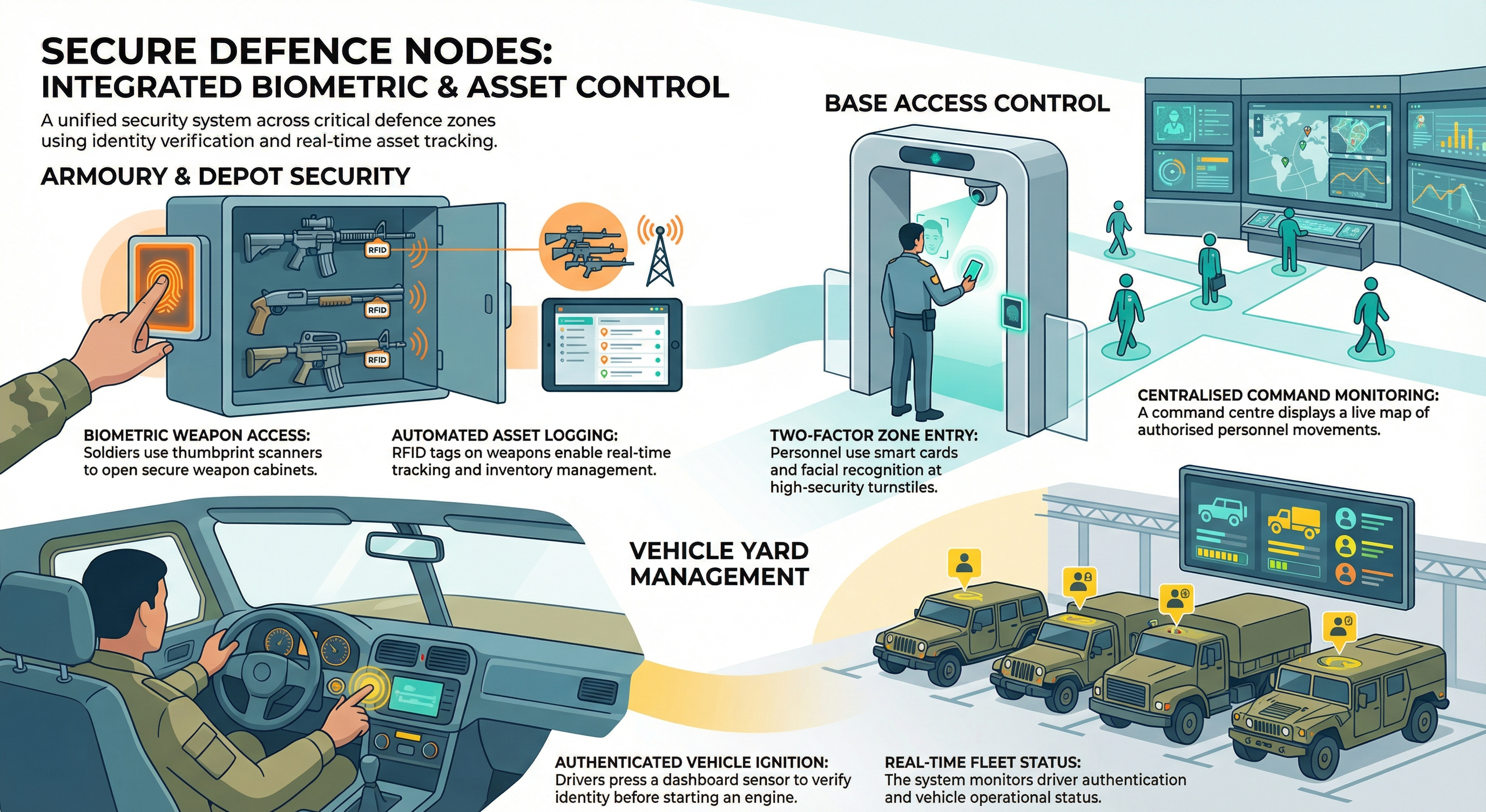
Equipment and vehicle yards also see improved efficiency. RFID tracking of mission-critical vehicles allows for real-time status updates on asset availability. Biometric validation for drivers ensures that only qualified operators can start the ignition of heavy machinery. This prevents accidents and unauthorized use of expensive logistics fleets.
Operational and Strategic Benefits
The integration of RFID and biometric systems strengthens defence security at both operational and strategic levels.
Audit readiness is another major proviso for adopting this technology. Automated logs support internal audits and investigations without the need for manual data entry. This reduces the administrative burden on soldiers and allows them to focus on their core duties. The data is immutable meaning it cannot be altered after the fact.
Biometric accountability significantly lowers the risk of internal misuse. This leads to insider threat reduction in military environments. When personnel know that their specific biometric data is tied to an asset transaction, they are less likely to engage in "friendly" theft or negligent behaviour. The psychological deterrent is as powerful as the physical lock.
End-to-end traceability of weapons and ammunition becomes a reality. From storage to deployment every asset movement is digitally recorded. This creates a level of transparency that is impossible with paper records. It removes the guesswork from logistics.
It moves the organization toward a Zero-Trust Security model. In this model every access attempt is verified and logged. There are no assumptions of trust based solely on being inside the perimeter.
India’s Defence Modernisation Context
India’s defence ecosystem is rapidly modernising with a strong focus on secure indigenous defence infrastructure. The push for Atmanirbhar Bharat defence technology drives the need for solutions that are developed and deployed with local strategic interests in mind.
Defence installations in India require technologies that operate reliably in diverse environments. Equipment must function in the freezing temperatures of high-altitude borders and the humid conditions of coastal depots. This demands ruggedized hardware that meets military standards for durability.
RFID and biometric systems align closely with the vision of a modernized Indian military base. They enable scalable and auditable access control that prepares the infrastructure for future digital integration. This is not just about catching up with global standards but setting a new benchmark for logistics security in the region.
The Defence Deployment Checklist
For defence organisations planning infrastructure upgrades it is vital to ensure the solution meets critical criteria.
Multi-factor authentication is the first requirement. The system must support a combination of Biometric scans and Smart Cards or PINs to layer security.
Secure audit logs must be encrypted and immutable. This ensures compliance and prevents any attempt to manipulate the records.
Tamper-resistant tagging is essential. RFID tags must be durable enough to withstand the wear and tear of military-grade equipment. If a tag falls off the traceability is lost.
A centralized dashboard allows headquarters to monitor multiple remote depots from one screen. This provides strategic oversight of all assets across the country.
Offline authentication for defence is a non-negotiable feature. Systems must authenticate users even when the network is down. This is often achieved through Edge AI where the biometric database is securely cached on the local device.
Conclusion
Defence organisations today face increasing pressure to modernize logistics without compromising security. Fragmented systems and manual processes are no longer sufficient to hold back the tide of modern threats. They act as a subversive drain on efficiency and readiness.
RFID and biometric systems offer a proven and scalable approach to securing defence logistics. By unifying identity verification with asset traceability they provide defence forces with the visibility required for mission-ready operations. We must give preferment to these integrated security frameworks as the foundation for long-term operational resilience. The shift from manual trust to digital verification is the only path forward.
Comments