Introduction
Cloud dependency is becoming a bottleneck for modern security. Edge AI in biometric devices moves the "brain" of the system directly into the hardware. This shift cuts authentication time from seconds to milliseconds, keeps sensitive biometric data off the public internet, and allows security systems to work perfectly even when the internet goes down. Solution providers like Mantra Softech have adopted this approach early, integrating neural processing units directly into hardware to ensure that speed and security happen at the source, not in a server room. This article breaks down the technical architecture, the specific privacy benefits, and why embedded computers are replacing server-based identity management.
Why Edge AI Matters in Modern Biometric Systems
Old school biometric authentication depended on centralised servers or cloud platforms. While this model made it easy to store millions of records, it introduced lag.
As biometric deployments expand into high security and high traffic environments like defence installations or busy corporate lobbies, the cracks in cloud centric architectures appear. If the network drops, the door stays locked. If the server slows down, the queue builds up.
Edge AI fixes this. By embedding artificial intelligence directly inside biometric devices, identity verification happens locally. It is real time and independent of internet quality. This is not just a small upgrade. It fundamentally alters how we design security.
On-Device vs Cloud Biometric Processing
The core difference between edge and cloud biometric systems is physical location. It is about where the math happens.
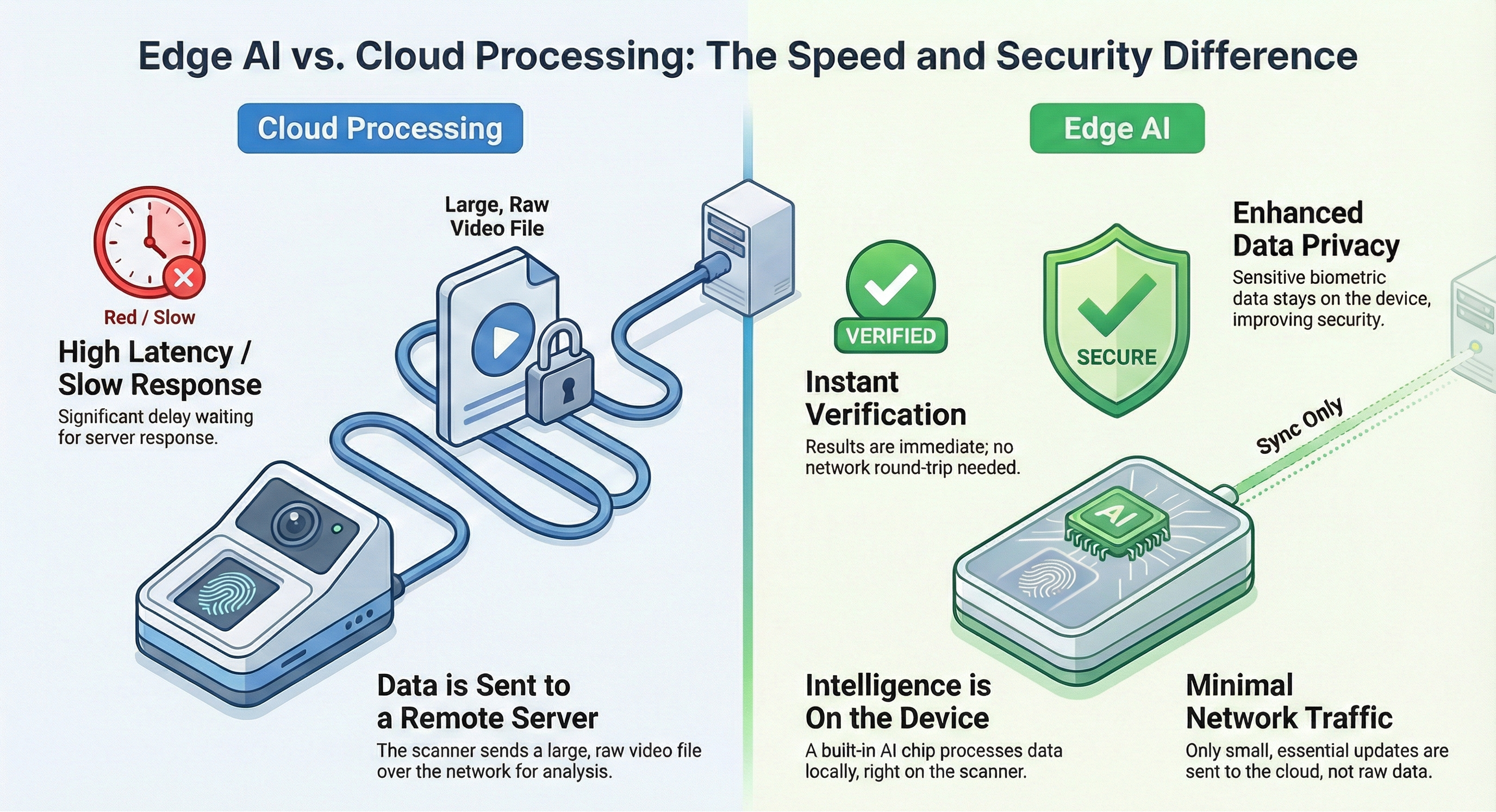
In cloud-based processing, the device is just a camera. It captures data and sends it away. This exposes data in transit and creates a single point of failure. If the cloud is down, your security is down.
Edge AI systems differ because they act as a standalone embedded computer. They perform capture, analysis, and decision making entirely on the device.
| Dimension | Cloud-Based Biometrics | Edge AI Biometrics |
|---|---|---|
| Latency | Network-dependent | Near-instant |
| Privacy | Data transmitted | Data stays on device |
| Reliability | Requires connectivity | Works offline |
| Security exposure | Higher attack surface | Reduced surface |
| Scalability cost | Ongoing cloud costs | Predictable device cost |
For environments where milliseconds matter, edge processing provides a decisive advantage.
How AI Models Run on Biometric Terminals
Modern biometric devices are no longer simple sensors. They are sophisticated computing platforms capable of running optimised AI models under strict power limits. This is what we call on device AI.
Spoof and presentation attack detection
Edge AI identifies spoofing attempts in real time. Because this happens on the chip, the system blocks the attack before any data is even formatted for transmission.
Template extraction and matching
Instead of sending a photo of your face, the device converts your features into a mathematical string called a template. It performs the matching locally.
Image enhancement and denoising
Industrial environments are messy. AI based preprocessing cleans up the input quality. It compensates for poor lighting in a warehouse or dust on a sensor.
Liveness detection
This is the first line of defence. AI models analyse texture, depth cues, and blood flow patterns to confirm that the face in front of the scanner is a live human. It instantly rejects photos, videos, or silicone masks.
These models use techniques like quantisation. This shrinks the AI brain so it fits on a small chip without losing intelligence.
Security and Privacy Advantages of Edge AI
From a security architecture perspective, edge AI reduces risk by reducing exposure.
When biometric data is processed locally, raw biometric samples never touch the network. There are no APIs to intercept and no cloud databases to hack. This makes compliance with strict regulations easier. Since the data stays on the hardware, you are naturally following the principle of data minimisation.
For regulators and enterprises, edge processing aligns with privacy by design principles. It proves that you are serious about protecting user data.
Use Cases Where Edge AI Delivers Clear Value
Offline Attendance and Workforce Systems
Factories and construction sites rarely have fibre optic internet. Edge AI allows biometric attendance systems to function fully offline. Workers clock in, the device verifies them instantly, and the data syncs later when the connection returns.
Border Control and Secure Checkpoints
At an immigration counter, every second counts. On device AI enables instant identity verification without waiting for a central database query. This reduces bottlenecks and keeps lines moving.
Remote and High-Security Sites
Mining sites and energy grids are often in dead zones. Edge AI ensures secure access control in air gapped environments where no external connection is allowed for security reasons.
Performance and Power Trade-Offs in Embedded AI
Running AI models on small devices involves engineering trade-offs. You cannot just throw more power at the problem like you can in the cloud.
Compute vs power consumption is the main balance. Higher accuracy models need more processing power, which drains the battery. Engineers must find the sweet spot.
Model size vs memory constraints are another challenge. Embedded systems have limited RAM. The AI model must be efficient enough to fit without choking the system.
Accuracy vs speed is the final test. Real time authentication needs to happen in under a second, but it cannot sacrifice precision.
Successful edge AI biometric devices combine hardware acceleration with intelligent workload scheduling to manage these trade-offs.
Reliability and Operational Resilience
Resilience is the ability to take a hit and keep working. Systems that depend entirely on cloud connectivity are fragile. They break during outages or cyber incidents.
Edge enabled biometric devices are robust. They provide consistent authentication regardless of the network status. For a security architect, knowing the door will open for the right person, every single time, is worth more than any other feature.
Edge AI as a Differentiator
Intelligence is moving closer to the sensor. Devices that can think, decide, and secure data locally are becoming the standard.
Manufacturers are now embedding Neural Processing Units (NPUs) alongside standard CPUs. This hardware evolution allows platforms from companies like Mantra Softech to execute complex logic at the edge. This enables secure and scalable deployments that simply were not possible five years ago.
The Future of Edge AI in Biometrics
Looking ahead, edge AI in biometrics will get faster and smarter. We will see more efficient neural network architectures that do more with less power.
Dedicated AI accelerators in biometric chips will become standard. We will also see adaptive models that learn from their environment to improve accuracy over time.
As these capabilities mature, edge AI will not just be an alternative to the cloud. It will be the default architecture for all physical security.
Conclusion
Edge AI transforms biometric devices from passive readers into intelligent security guards. By processing data locally, organisations gain speed, privacy, and reliability.
For CTOs and security architects, edge AI is no longer an experiment. It is the baseline requirement for a modern, secure identity system.
Comments