Peace Sign Selfies, Photo-Sourced Biometrics, and Enterprise IAM: Reality vs. Hype
Most people posting a selfie think about lighting, framing, or a flattering filter. Almost none of them think about the ridge-valley patterns on their fingertips. This gap in awareness is where security researchers and privacy advocates have identified a modern vulnerability: the potential to extract fingerprint data from high-resolution photographs.
The concept has recently gained mainstream visibility. In April 2026, security expert Li Chang demonstrated on a mainland Chinese reality program how widely available AI tools and photo-editing software could extract fingerprint ridges from a celebrity's selfie. Similarly, Jing Jiwu, a cryptography professor at the University of Chinese Academy of Sciences, noted that portrait-quality photos taken on high-resolution devices could make it possible to reconstruct hand detail from a "scissor hand" or "peace sign" pose, provided factors like lighting, focus, and distance align.
This threat is real, but it is often misunderstood. For Identity and Access Management (IAM) and enterprise security professionals, the critical task is to separate the sensationalized "photo-to-hack" narrative from the actual threat model, and to design authentication architectures that render these vulnerabilities irrelevant.
The Threat Model: Local, Physical, and Targeted
To address this vulnerability, security architects must define the exact threat vector. Extracting a fingerprint from a social media photo does not allow a hacker to execute a remote, automated, or scalable network attack.
Unlike a compromised password or session token, a reconstructed fingerprint is a localized, physical-proximity attack vector. For an attacker to exploit an extracted fingerprint, several demanding conditions must be met:
Specific Capture Conditions:
The source image must be high-resolution, taken under 1.5 meters from the lens, with the fingertip pads facing the camera directly under optimal lighting.
Targeted Effort:
The attacker must manually identify a high-value target, scour their public profiles for compliant photos, and utilize advanced image enhancement tools to reconstruct a coherent 2D template.
Physical Access:
The attacker must physically fabricate a 3D replica (such as a conductive silicone mold) and physically apply it to the victim's specific device or local access reader.
Because an attacker cannot use a stolen fingerprint to log into an enterprise cloud portal or SaaS application from a remote server, the threat is fundamentally limited to targeted physical device theft or unauthorized entry into physical facilities.
How AI Fingerprint Extraction From Social Media Photos Actually Works
You might reasonably think: a compressed, filtered Instagram image can't carry enough data to matter. Fingerprint recovery remains genuinely difficult under poor lighting, at oblique angles, or from low-resolution sources.
The risk does not live in every photo. It concentrates in the intersection of several conditions: high resolution, direct fingertip orientation toward the lens, shooting distance under approximately 1.5 metres, and an attacker who has multiple related images to cross-reference.
The attack requires patience, the right targets, and access to tools that have become broadly available. Security architects and identity professionals need to understand each link in this chain individually, because breaking any single link is a valid defensive strategy.
Attackers scan public social media accounts, searching specifically for high-engagement posts involving hand-forward poses. Hashtag searches such as "#miniature," "#finger," and "#myhand" collectively surface millions of posts on Instagram alone; the researchers found these hashtags returning over 4.3 million, 1.25 million, and 212,000 posts respectively at the time of their study.
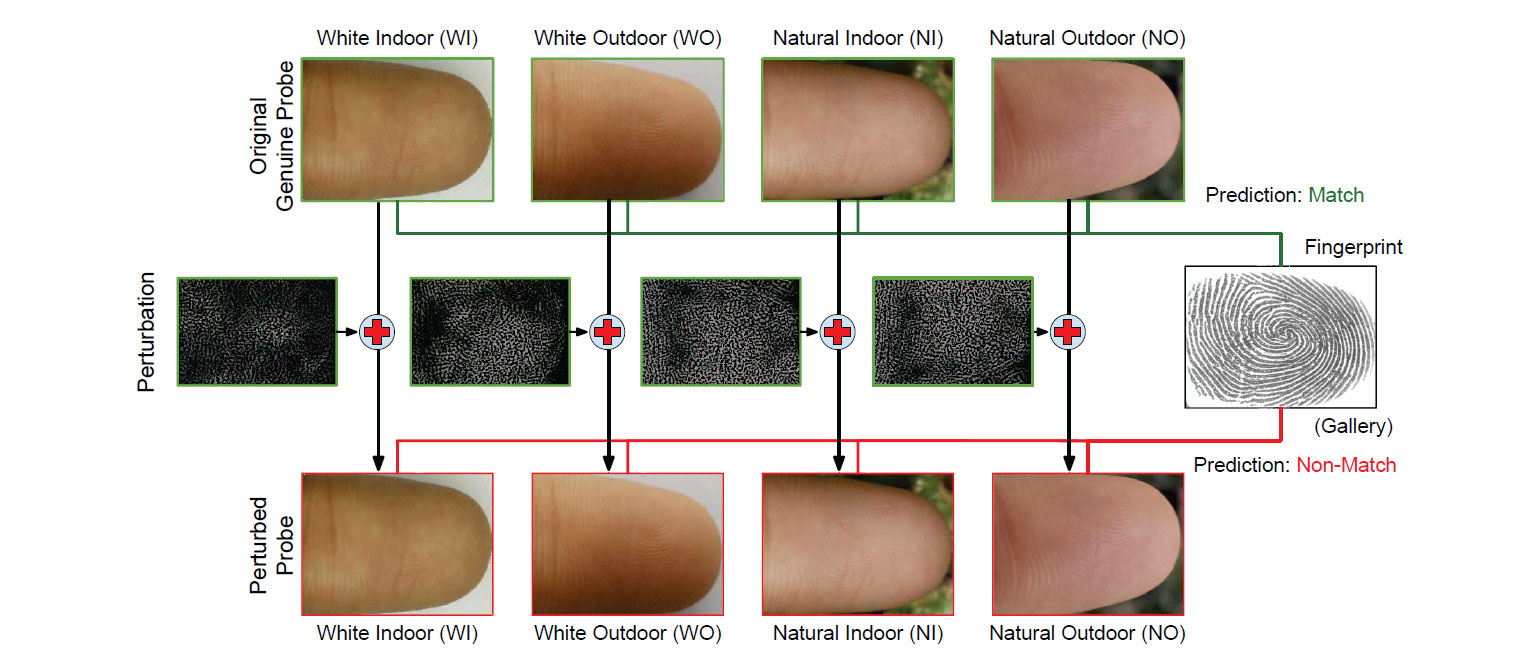
Original genuine finger-selfie images getting misclassified as non-match after adding the perturbation image.
Next, the attacker runs the photograph through AI-based super-resolution and contrast enhancement. The research showed that the highest learned perturbation concentrated specifically inside the finger region and near singular points in the fingerprint, which confirms that AI models identify precisely these anatomical features as information-rich zones.
Notably, skin-color segmentation techniques allow enhancement to isolate finger regions from background clutter, improving reconstruction accuracy. The enhanced image then feeds into a fingerprint feature extraction pipeline.
Liveness Detection and Hardware Enclaves
While academic research - such as the study by Malhotra, Chhabra, Vatsa, and Singh - demonstrated that deep learning networks could match finger-selfies to livescan databases with 89.09% accuracy, translating a 2D digital image into a working physical spoof remains a formidable material-science challenge.
Legacy, first-generation optical fingerprint readers simply captured a 2D image of a finger, making them highly vulnerable to basic physical spoofs (such as printed paper or simple gelatin molds).
Modern enterprise-grade biometric sensors and contemporary smartphones mitigate this by employing active Liveness Detection (LD). These systems measure physiological markers that cannot be replicated by a physical mold constructed from a photo:
Capacitive and Ultrasonic Sensors:
Measure the electrical conductivity and acoustic depth of living skin, rejecting inert materials like silicone or latex.
Multispectral Imaging:
Analyzes subdermal tissue layers, blood flow, and pulse signatures beneath the surface of the skin.
The most robust defense against photo-sourced biometric theft is architectural. Modern passwordless standards, such as FIDO2 and WebAuthn, change the role of the biometric entirely.
In a FIDO2-compliant architecture:
The biometric template never leaves the local device and is never transmitted over the network.
The fingerprint does not serve as a shared secret. Instead, it acts as a local verification gesture to unlock a hardware-bound private cryptographic key stored securely inside the device's Trusted Platform Module (TPM) or Secure Enclave.
Even if an attacker somehow obtains a perfect physical replica of a user's fingerprint, they still cannot authenticate unless they also have physical possession of that user's specific, registered hardware device.
By binding the biometric verification locally to the hardware, the attack surface is reduced from a global network vulnerability to a highly difficult, localized physical threat.
Actionable Playbook for Identity Security Teams
Enterprise security teams cannot control the personal social media posting habits of their employees. Instead, organizations should secure their systems through structural IAM policies that assume biometric data can be publicly exposed.
If your organization utilizes fingerprint readers for physical facility access, audit these systems immediately. Legacy optical readers that lack liveness detection should be phased out. Ensure all physical biometric readers utilize multispectral imaging and advanced liveness detection to block fabricated silicone or gelatin molds.
Transition enterprise digital authentication away from centralized biometric databases or legacy identity providers. Deploy FIDO2/WebAuthn (such as Passkeys) across all corporate systems. This ensures that a compromised biometric cannot be used globally without the associated physical hardware token.
For high-value systems, biometric verification should never be the sole gatekeeper. Combine local biometric verification with contextual risk signals, such as:
Device Binding: Ensuring the request originates from an MDM-enrolled corporate device.
Behavioral Analytics: Verifying typing cadences, mouse movements, or typical application access patterns.
Geographical Context: Flagging impossible travel or anomalous IP addresses.
Unlike a password, a compromised fingerprint cannot be rotated or reset. If an employee's biometric credential is known to be targeted, or if they have suffered a physical device theft, the IAM team must have a clear protocol to instantly revoke the registered device binding and transition the user to alternative hardware-bound credentials (such as physical FIDO2 security keys) without relying on fingerprint input.
Comments