The shift from passive video storage to active, smart cameras is arguably the most significant change in enterprise security in the last ten years. Deploying an Intelligent Video Surveillance Systems (IVSS) means leaving behind basic Video Management Systems (VMS).
You are now working with smart, interconnected tools that analyze data right at the camera's lens, combine information from multiple sensors, and send fast, accurate alerts. This article breaks down the full data pipeline so you can understand how modern surveillance systems extract meaning from a scene in real time.
Cloud vs. Edge Processing
Where you process your data determines how smart your system actually is. Get this wrong, and no AI model can fix it.
Legacy systems pushed raw video streams across the network to a centralized computer cluster. That model suffers from severe bandwidth bottlenecks and crippling lag times. More cameras meant more congestion, not more insight.
Modern Intelligent Video Surveillance Systems distribute the compute power instead:
Running Edge Inference.
Dedicated Neural Processing Units (NPUs) inside the camera execute primary AI models locally. The camera processes its own raw 4K stream without waiting for a central server to do the heavy lifting.
Streaming Metadata, Not Video.
Rather than transmitting heavy, raw footage, the camera uses ONVIF Profile M - the standard for analytical metadata - to stream lightweight text files. These files carry the shapes, paths, and categories of objects. This keeps the network fast and uncluttered.
Deploying Hybrid Video Surveillance as a Service (VSaaS).
The local analytics server ingests this lightweight data for immediate alerts - offering near-zero latency for actions like physical access lockdowns. Longer-horizon behavioral analysis, such as queue analytics and dwell time, moves to the cloud where compute power is cheap and elastic.
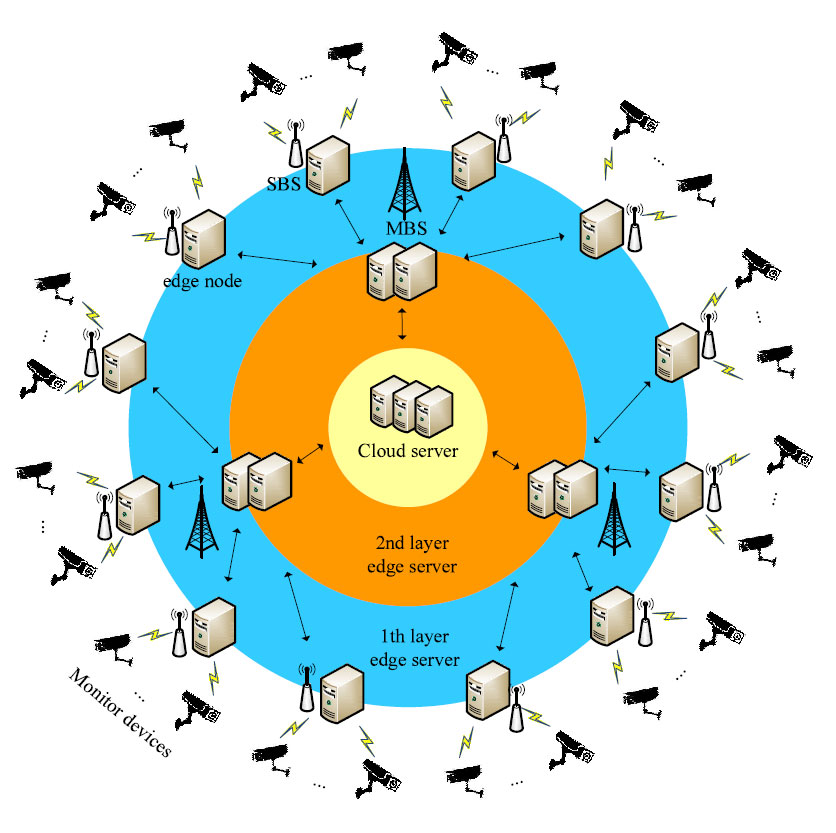
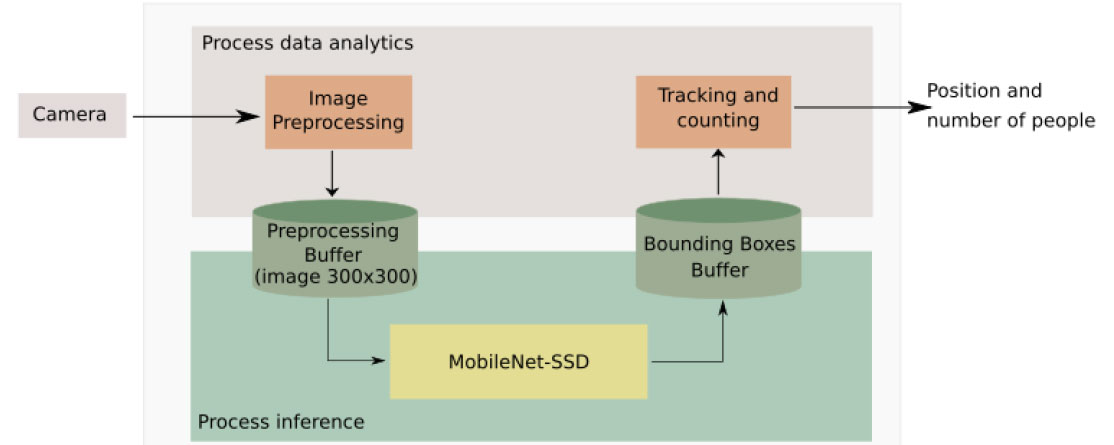
The architecture of the proposed DIVS system.
Understanding How AI Actually Reads a Scene
An IVSS does not see a scene the way a human does. It computes through a sequential pipeline of neural networks, each layer building on the last. To reach what practitioners call Level 4 Scene Understanding, the architecture needs four distinct computational layers working in sequence.
Extracting Features
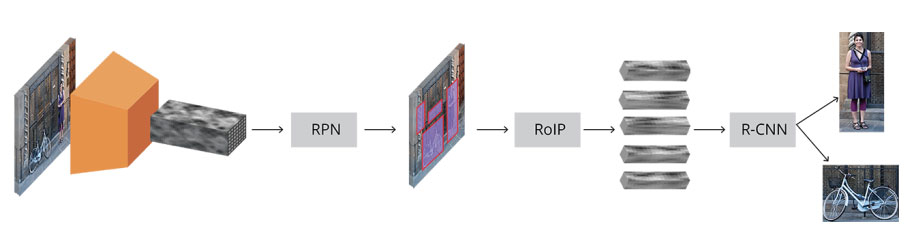
Faster R-CNN is equipped with Region Proposal Network (RPN) in order to rapidly and efficiently process the whole frame and determine the region of interest that needs further processing.
First, the camera converts a picture into a grid of pixel values. An AI tool called a Convolutional Neural Network (CNN) then sweeps filters across that grid to spot patterns. Early filter layers detect basic spatial patterns - edges and high-contrast boundaries. Deeper layers turn those edges into recognizable textures and shapes. The final result is a set of bounding boxes, each tagged with a confidence score: for example, Class: Vehicle, Confidence: 94.2%.
Predicting Trajectories
Spotting an object in one frame tells you almost nothing. To understand activity, the system must track an object's identity across hundreds of consecutive frames. Intelligent Video Surveillance Systems typically use specialized tracking math (Multi-Object Tracking paired with Kalman filters) to accomplish this. The math predicts where a detected object should appear in the next frame based on its current speed and direction. By comparing that prediction against the AI's actual detection, the system assigns a persistent ID and calculates a precise spatial trajectory for each entity in the scene.
Building Temporal Memory
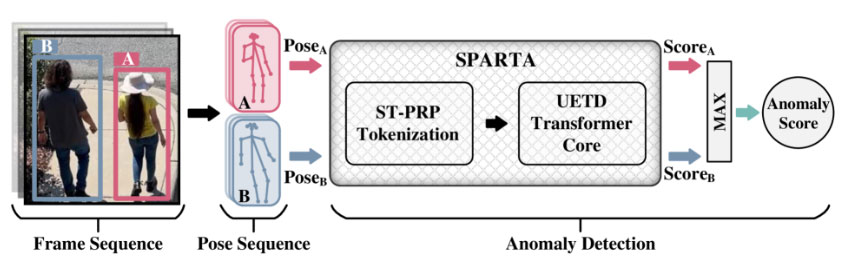
Assigning higher scores to anomalous pose sequences. The final frame score is the maximum score of all individuals in the scene.
Standard CNNs suffer from a significant limitation: they analyze frames in isolation. They have no memory. To detect behaviors like tailgating or loitering, the system needs to connect events separated by time. Advanced AI tools called Spatio-Temporal Transformers handle this by giving the camera a memory. They compare every frame in a sequence against every other frame simultaneously - not sequentially. Because of this, the system can mathematically link a person dropping a bag at the start of a minute and walking away at the end of it, classifying the combined sequence as an abandoned object event.
Computing Relationships
Context comes from relationships, not just individual objects. Graph Neural Networks (GNNs) map the scene like a mathematical spiderweb to capture those relationships. Nodes represent detected entities - Person A, Person B, or a secured door. Edges represent the spatial distance and time relationship between those nodes. If the distance between two people shrinks rapidly and their movements intersect erratically, the system spots a high probability of a physical altercation. One model makes one quick judgment across the whole scene at once.
Fusing Sensors and Calibrating the System
Cameras alone have blind spots. A bag blocks a face. A shadow obscures a doorway. Enterprise-grade IVSS architectures compensate by combining data from different types of sensors. The analytics server ingests camera metadata alongside data from access control systems (like keycards or Bluetooth), thermal imaging, and laser scanners (LiDAR). A mathematical engine combines those streams into a unified Threat Confidence Score that reflects the full picture, not just what one camera saw.
Running this engine well requires careful mathematical tuning. Security teams tune the alerting threshold to balance false alarms against missed real threats. Set the threshold too high - say, 99% - and the system produces dangerous false negatives, missing genuine threats. Most enterprise deployments calibrate thresholds between 85% and 92%, then add human verification for borderline anomalies. That combination works better than pure automation at either extreme.
Privacy-Preserving Biometrics and Compliance Frameworks
Because Intelligent Video Surveillance Systems compute human behavior, regulatory bodies treat them as high-risk data processors. Modern architectures sidestep many of those liabilities by removing personal data directly at the camera, before it ever moves.
Under guidelines from the NIST Face Recognition Vendor Test (FRVT), compliant systems do not store or transmit actual photos of faces. Instead, the camera maps the geometric features of a face and converts them into one-way mathematical codes called face embeddings. The original image is never saved.
Cameras update their local neural network weights without transmitting raw training data to a central server, keeping data sovereignty intact throughout the pipeline.
When the analytics server tracks crowd movement or builds heat maps, it injects calibrated mathematical noise into the dataset. You can still calculate how the overall crowd flows, but reversing that noise to reconstruct any individual's specific route is mathematically impossible.
Final Thoughts
The era of passive video recording is over. Today, Intelligent Video Surveillance Systems represent a fundamental shift in how we approach security and operational intelligence. By pushing the heavy AI work to the edge of the network - right at the camera's lens - organizations can now scale their security without choking their networks or breaking their budgets. More importantly, they can do this while actively protecting individual privacy. Ultimately, when you deploy an IVSS, you stop simply storing video for tomorrow and start actually understanding your physical space today.
Comments