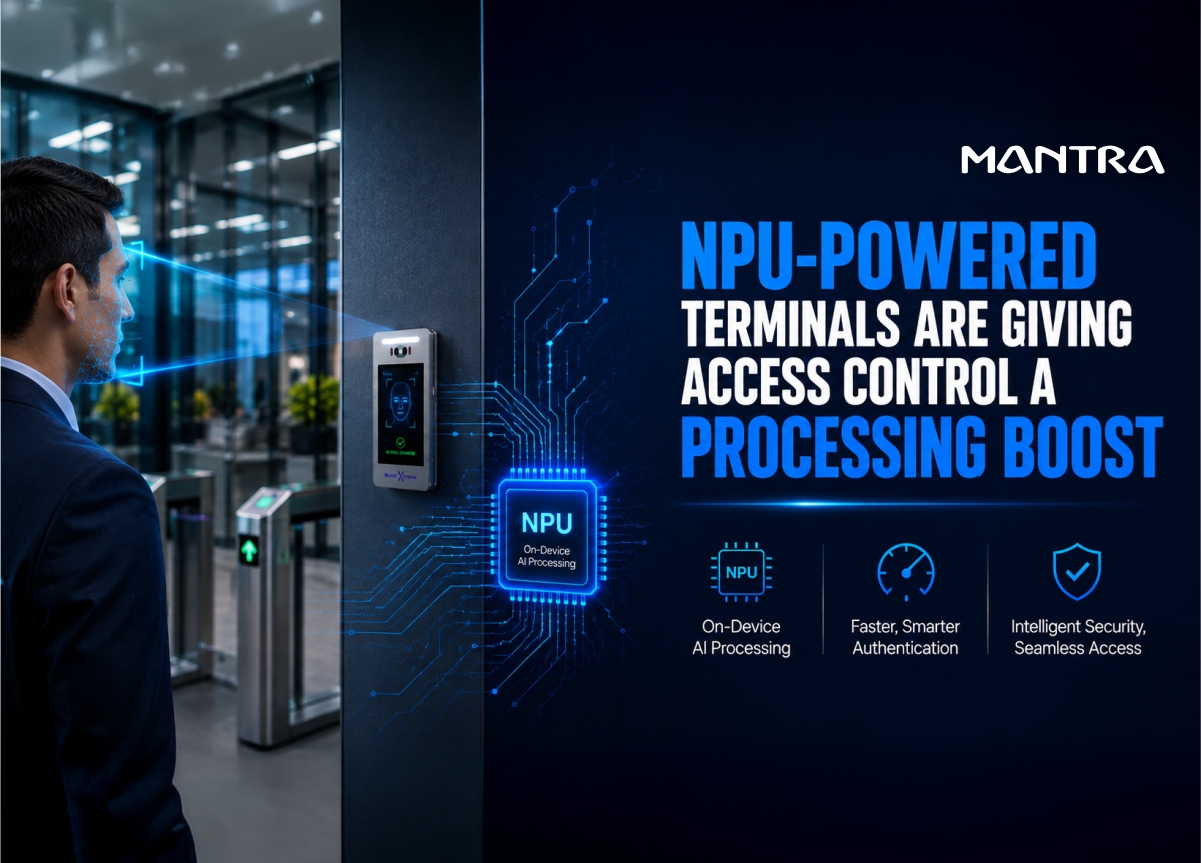
At 9:00 AM in any large corporate park or manufacturing plant, hundreds of employees arrive at the security turnstiles at the exact same time. With older access control systems, such as RFID swipe cards, fingerprint readers, or early facial recognition cameras, this rush hour regularly creates long queues and entry delays.
Today, physical security hardware is undergoing a major processor upgrade. Biometric manufacturers are replacing standard computer processors with dedicated Neural Processing Units (NPUs) inside door access terminals.
Integrating NPUs into physical entry systems directly addresses high-throughput access control, which is the ability to verify and admit a large volume of people continuously without making them stop and wait.
CPU vs. NPU: How the Hardware Changed
To understand why modern terminals are faster, facility managers have to look at the processor inside the device. Historically, biometric terminals ran on a Central Processing Unit (CPU). A CPU is a general-purpose chip built to handle basic sequential tasks, such as running the display screen, managing Wi-Fi connections, and opening the door relay.
However, scanning a human face in three dimensions requires running thousands of mathematical calculations at the exact same millisecond. When a standard CPU tries to process live video feeds and biometric matching algorithms simultaneously, the processor slows down and generates heat.
An NPU (Neural Processing Unit) is a specialized microchip built specifically to run artificial intelligence and facial matching calculations in parallel. Hardware engineers measure NPU speed in TOPS, which stands for Trillions of Operations Per Second. For example, the Mantra BioNIC Xtreme XI pairs a multi-core ARM processor with a dedicated 5 TOPS NPU, while the Nialabs NiaFace A90 runs on a 1.2 TOPS NPU. Placing an NPU directly inside the door terminal allows the device to run heavy facial recognition math instantly without taxing the main system processor.
Removing the Cloud Delay with Edge Processing
Before compact NPUs became affordable for commercial security hardware, accurate facial recognition required large servers. Because a small wall-mounted reader lacked that computing power, it relied on cloud or central server processing. The camera at the door captured an employee's photo, sent it over the local network or internet to a central server, waited for the server to match the face, and waited for the unlock signal to return. That network round-trip created a two-to-three-second delay per person, which quickly backed up a lobby when 500 employees arrived within ten minutes.
Blocking Fake Photos and 3D Masks
Fast entry speeds create a security risk if the camera can be tricked by a fraudster. Early 2D facial recognition cameras occasionally granted access when shown a printed photograph or a video playing on a smartphone screen.
Because an NPU processes large amounts of visual data at once, hardware makers pair these chips with binocular dual cameras that combine a standard color (RGB) sensor with a Near-Infrared (NIR) sensor. Manufacturers like Mantra Softech, use NPU chips to run real-time liveness detection. The NPU checks the 3D depth of the face, surface skin texture, and infrared light reflection to confirm a living human is standing in front of the lens.
On-Device Privacy and Local Template Storage
Storing employee biometric records on external cloud servers creates data privacy and cybersecurity liabilities for companies. If a central server is breached, thousands of sensitive records can be exposed.
Because NPU terminals verify faces on the device itself, biometric templates do not need to travel over the internet during daily check-ins. Modern edge terminals also hold large local databases such as the Mantra BioNIC Xtreme XI stores 50,000 face templates and 1,000,000 transaction logs directly on the unit, matching faces in 300 milliseconds with over 99.9 percent accuracy under normal indoor lighting.
What This Means for Enterprise HR and Security
Looking beyond the microchip specifications, the shift toward NPU-based access terminals changes three operational areas for large organizations:
Comments