Every day, millions of people press their thumbs against smartphone sensors, corporate office turnstiles, and banking point-of-sale terminals to verify their identities in less than a second. This routine raises a common privacy question among users: do commercial biometric scanners store a massive database filled with photographs of people's fingerprints?
The factual answer is no. Certified commercial access control systems, smartphones, and national banking scanners do not save raw photographs of a user's finger. Instead, they convert specific physical ridge markers into a compact numerical file and erase the original image from memory.
Below is the exact hardware and mathematical process that takes place inside a fingerprint scanner during that fraction of a second.
Step 1: The Sensor Capture and Liveness Detection
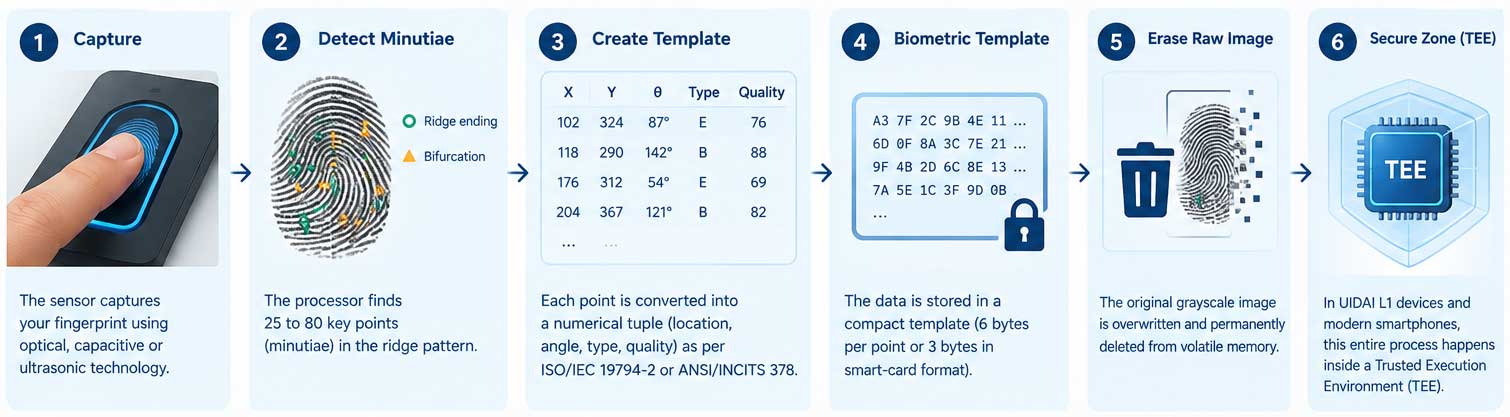
When a person places a finger on a scanner platen, the hardware captures the physical geometry of the skin using one of three primary sensor technologies:
To block attackers who press 3D-printed silicone molds, latex casts, or conductive gelatin fingers against the reader, certified scanners run hardware-level Presentation Attack Detection (PAD), tested under the international ISO/IEC 30107-3 anti-spoofing standard. Modern sensors emit multi-spectral or near-infrared light to check sub-dermal blood flow, sweat pore activity, and the natural dielectric constant of living human tissue. In India, the Unique Identification Authority of India (UIDAI) enforces this through mandatory Level 1 (L1) Registered Devices equipped with on-board Fake Finger Detection (FFD).
Step 2: Image Thinning and Minutiae Extraction
Once the sensor captures the temporary grayscale array in volatile memory, the processor does not keep the full fingerprint pattern. Instead, an algorithm (such as the open-source mindtct extractor in the NIST Biometric Image Software suite) runs three rapid image-processing steps:
While human friction ridges contain several structural shapes (including islands, enclosures, spurs, and deltas), automated biometric standards focus primarily on two stable features:
Forensic dermatoglyphics research shows that a complete, rolled human fingerprint contains an average of 150 individual minutiae points. However, a flat touch sensor only contacts the center of the finger pad. Depending on sensor surface area and finger pressure, a standard 500 ppi live scan extracts between 25 and 80 high-quality minutiae points. In automated matching mathematics, aligning just 12 to 15 of these spatial points is sufficient to verify identity across millions of users.
Step 3: Converting Coordinates into an ISO/IEC 19794-2 Template
This mathematical conversion is the core mechanism that protects user privacy. Once the processor isolates those 25 to 80 minutiae points, it formats them according to the global ISO/IEC 19794-2 Fingerprint Minutiae Record (FMR) standard (or the equivalent ANSI/INCITS 378 specification).
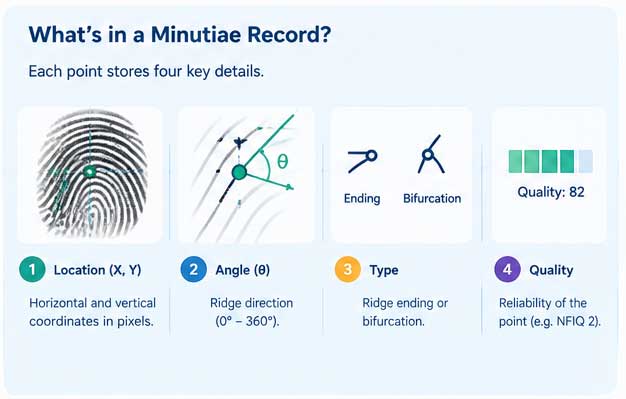
For every single minutia point detected, the algorithm records a mathematical tuple:
Mi = {xi, yi, θi, ti, qi}
Under the ISO/IEC 19794-2 standard, each minutia point takes up only 6 bytes of data in the standard record format (2 bytes for the X coordinate and type, 2 bytes for the Y coordinate, 1 byte for the angle θ, and 1 byte for quality), or just 3 bytes per point in the compact smart-card format.
As soon as the processor compiles this numerical array into a biometric template, the raw grayscale fingerprint image is overwritten and permanently erased from the device's volatile RAM. In modern UIDAI L1 Registered Devices and smartphone secure enclaves, this entire extraction and deletion cycle happens inside an isolated hardware chip zone called a Trusted Execution Environment (TEE). Not even the main operating system of the phone or computer can view or intercept the raw image before it is wiped.
Step 4: Tiny Storage Size and Geometric Graph Matching
What gets saved inside an enterprise access controller, smart card chip, or encrypted authentication packet is solely that numerical minutiae file.
Looking at the file sizes shows the difference between an image and a template:
When a user returns the next day and touches the reader, the sensor generates a fresh live template in RAM. Because a human never places their finger at the exact same pixel position, rotation angle, or skin pressure twice, the scanner cannot compare the two files like a static text password. Instead, the matching engine runs a spatial alignment algorithm that rotates and shifts the new coordinate set (x', y', θ') against the stored reference set (x, y, θ), calculating the Euclidean distance and angular tolerances between neighboring points. If the spatial alignment score crosses the security threshold, the door unlocks and the live probe template is immediately deleted.
Comments