The Unique Identification Authority of India (UIDAI) manages the biometric and demographic records of over 1.55 billion people. When an identity database operates at this size, even a tiny error rate creates hundreds of thousands of duplicate records. In July 2022, the Ministry of Electronics and Information Technology informed the Lok Sabha that UIDAI had cancelled nearly 6 lakh duplicate Aadhaar numbers as of May 31, 2022, while spending Rs. 981.69 crore on system enrolments and updates.
Duplicate registrations happen for two main reasons. In many cases, a citizen enrolls at an Aadhaar center, does not receive their card within a few weeks, and visits another center to apply a second time. In other cases, individuals intentionally submit multiple applications under different names to claim welfare subsidies twice.
To detect and block these duplicates without relying entirely on foreign software companies, a team of researchers associated with UIDAI developed an open-source system called Bharat ABIS.
How Aadhaar Deduplication Worked Until Now
Whenever a resident applies for a new Aadhaar card, their biometric details go through a process called deduplication. The system compares the applicant's fingerprints, iris scans, and facial photograph against existing records in the database to confirm that the person does not already hold an Aadhaar number.
To run these checks, UIDAI currently uses commercial off-the-shelf (COTS) Automated Biometric Identification Systems (ABIS) built by three private technology vendors. While these private systems work accurately, they have three major limitations:
-
Their internal source code is closed and proprietary, meaning UIDAI engineers cannot inspect or modify the core matching algorithms directly.
-
Licensing and maintaining proprietary biometric software across a billion-plus database costs massive amounts of public money.
-
Matching a single biometric trait across 1.55 billion profiles often runs into accuracy problems when reading faded fingerprints from manual laborers, farmers, or senior citizens, as well as poor iris scans caused by medical conditions like cataracts, glaucoma, or corneal ulcers.
To solve these issues, six UIDAI engineers (Arka Koner, Chetan S. Naik, Lokesh Kurre, Vivek Raghavan, Barada P. Sabut, and Tanusree Deb Barma), along with Professor Anoop M. Namboodiri from the International Institute of Information Technology (IIIT) Hyderabad and biometric scientist Professor Anil K. Jain from Michigan State University, built a new system from scratch and published their findings in the May 2026 research paper titled Towards Billion-Scale Multi-modal Biometric Search.
What is Bharat ABIS?
ABIS stands for Automated Biometric Identification System. What separates Bharat ABIS from UIDAI's existing vendor software is that it is built entirely on open-source deep neural network models, meaning the software design is open to audit, modify, and upgrade without paying licensing fees to private companies.
Bharat ABIS is a multi-modal system. Instead of checking a single physical trait, it processes 10 fingerprints, 2 iris scans, and 1 facial photograph together to verify a person's uniqueness.
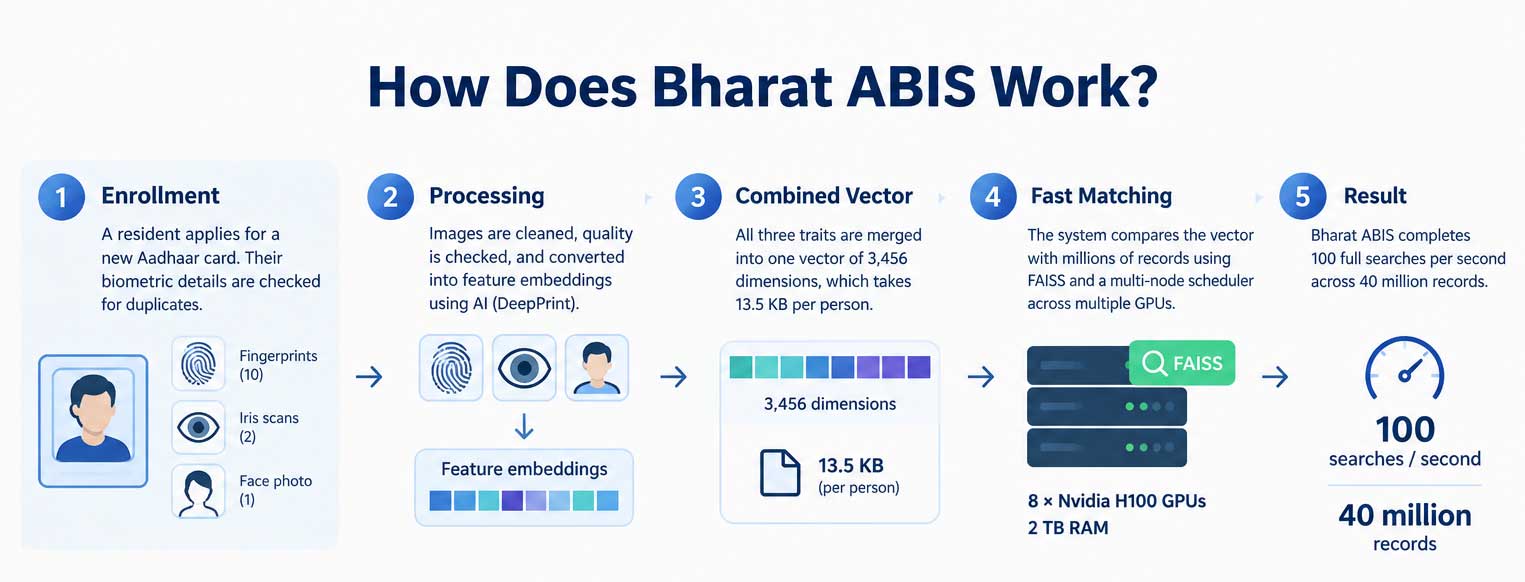
How Does Bharat ABIS Work?
When an enrollment packet enters Bharat ABIS, the system cleans the raw images, checks image quality, and converts the 10 fingerprints, 2 iris scans, and face photo into mathematical numbers called feature embeddings (using tools like the DeepPrint network trained on 3 million anonymized Aadhaar fingerprint images from 200,000 unique subjects).
The system then merges all three biometric traits into a single combined vector of 3,456 dimensions that takes up exactly 13.5 KB of storage space per person.
Because a 13.5 KB file is smaller than a basic text document, the computer can compare it against millions of existing records in milliseconds. To prevent servers from slowing down during massive searches, the engineers used the open-source FAISS similarity search library paired with a custom multi-node scheduler that divides the search workload across multiple graphics processors. Running on a single server equipped with 8 Nvidia H100 GPUs and 2 TB of RAM, Bharat ABIS completes 100 full searches per second across a gallery of 40 million records.
The research team tested Bharat ABIS against a de-identified gallery of up to 220 million actual Aadhaar records randomly sampled from the 1.55 billion population database, using a verified probe set of 37,835 known duplicate packets and 34,812 non-duplicate packets.
The test metrics proved that open-source software can match commercial systems:
-
220-Million Record Test
Across the full 220 million adult record gallery, Bharat ABIS recorded a False Negative Identification Rate (FNIR) of 0.3 percent at a False Positive Identification Rate (FPIR) of 0.5 percent.
-
20-Million Record Benchmark Against Commercial Vendors
When tested directly against the three commercial systems currently used by UIDAI on a 20 million record gallery (where UIDAI sets a strict vendor target of 0.5 percent FPIR and 0.1 percent FNIR), Bharat ABIS achieved an FPIR of just 0.1 percent (35 errors out of 34,812 queries) and an FNIR of 0.05 percent (18 errors out of 37,835 queries). That makes its error rate 2.5 to 5 times lower than UIDAI's baseline requirement on a 20-million-person database.
Why Bharat ABIS Matters for India and the World
Examining the technical design of Bharat ABIS highlights three major shifts in how national identity programs will operate in the coming years:
-
Adaptive Weighting for Manual Laborers and Seniors
Traditional biometric systems often reject citizens when one biometric input is damaged. Bharat ABIS uses age-specific and quality-adaptive weight settings. If a construction worker has worn-out fingerprints or an elderly citizen has corneal scarring, the algorithm automatically lowers the mathematical weight of the damaged trait and relies more heavily on the clear facial or iris scan, preventing false rejections during enrollment.
-
Eliminating Foreign Vendor Lock-In
Governments worldwide spend hundreds of millions of dollars on multi-year contracts with private biometric companies because switching vendors requires re-indexing every citizen's template. By proving that an open-source system can compress 13 biometric inputs into a standard 13.5 KB template and beat commercial accuracy on a 20-million gallery, UIDAI gives the Indian government negotiation leverage and a clear path toward software self-reliance.
-
Free Digital Public Infrastructure for Smaller Nations
While Bharat ABIS is still a research prototype and requires further engineering before replacing UIDAI's live 1.55-billion-record infrastructure, its current performance on 20 million to 40 million records is already production-ready for smaller countries. Developing nations with populations of 20 million or fewer can adopt this open-source architecture alongside India's MOSIP (Modular Open Source Identity Platform) to build their own national ID systems without paying expensive commercial vendor fees.
FAQs
Bharat ABIS (Automated Biometric Identification System) is an open-source, multi-modal biometric deduplication system developed by six UIDAI engineers in collaboration with researchers from IIIT Hyderabad and Michigan State University. It checks fingerprints, iris scans, and facial photos simultaneously to stop duplicate Aadhaar registrations.
Bharat ABIS extracts features from 10 fingerprints, 2 iris scans, and 1 face photograph, combining them into a single 13.5 KB digital template (3,456 dimensions) per person. It uses the open-source FAISS library and a multi-server scheduler across GPUs to compare new applicants against hundreds of millions of existing records in milliseconds.
In tests across 220 million anonymized Aadhaar records, Bharat ABIS achieved a 0.3 percent False Negative Identification Rate (FNIR) and a 0.5 percent False Positive Identification Rate (FPIR). On a smaller 20 million record benchmark against three commercial systems used by UIDAI, it recorded a 0.1 percent FPIR and 0.05 percent FNIR, outperforming UIDAI's baseline vendor targets by 2.5 to 5 times.
According to official data presented by the Ministry of Electronics and Information Technology in the Lok Sabha, UIDAI cancelled nearly 6 lakh duplicate Aadhaar numbers across India up to May 31, 2022.
No. As of late 2026, Bharat ABIS is an advanced research system tested on up to 220 million Aadhaar records. While it already matches commercial accuracy for databases of 20 million to 40 million people, further scaling and validation are required before it replaces the commercial systems running across UIDAI's full 1.55 billion record database.

Comments