India has been a pioneer in digital transformation.
From the 1994 National Telecommunications Policy to the rapid rollout of 5G today, the country has grown into the world's second-largest telecom market, with over 1.2 billion active subscribers.
Electronic Know Your Customer (eKYC) rules were first introduced in the financial sector to combat money laundering. Moving away from paper-based methods, India rolled out eKYC guidelines for banks as early as 2002 before extending the model to telecommunications.
That shift changed what a SIM card actually is.
It evolved from a basic, removable chip that connects a phone to a network into a strictly regulated digital identity credential. Reliance Jio's explosive 2016 launch made the case for this model at scale.
By replacing slow, paper-based forms with instant, Aadhaar-based biometric authentication, Jio activated SIMs in under five minutes instead of days, using portable biometric devices across thousands of retail outlets. The result: 50 million subscribers in 83 days.
That's the model eKYC was built to support: one verification event, at one point of sale, before a physical SIM leaves the counter. The eSIM breaks that assumption.
Understanding eSIM Technology
An eSIM (embedded SIM) is a non-removable chip soldered directly into a device's motherboard, replacing the plastic card entirely.
Using one requires a carrier-unlocked, eSIM-compatible device and eUICC (Embedded Universal Integrated Circuit Card), the software architecture that turns the chip into a container for multiple operator profiles. Consumers download these profiles remotely and switch between them over the air, without ever visiting a store.
That convenience is scaling fast.
Over 633 million new eSIM-enabled devices are projected to ship by the end of 2026, pushing the global installed base to roughly 3.3 billion consumer eSIM devices. For travelers, the appeal is immediate: connect to a local network within minutes of landing, skip the queue for a physical SIM, switch data plans by tapping an app instead of swapping cards, and top up instantly when running low.
Losing the device is less of a dead end too, since most carriers let an eSIM report a lost phone's location over Bluetooth, Wi-Fi, or mobile data. There's an environmental upside as well: fewer plastic cards and less packaging means eSIM and eKYC together form a genuinely lower-waste alternative to the traditional SIM supply chain.
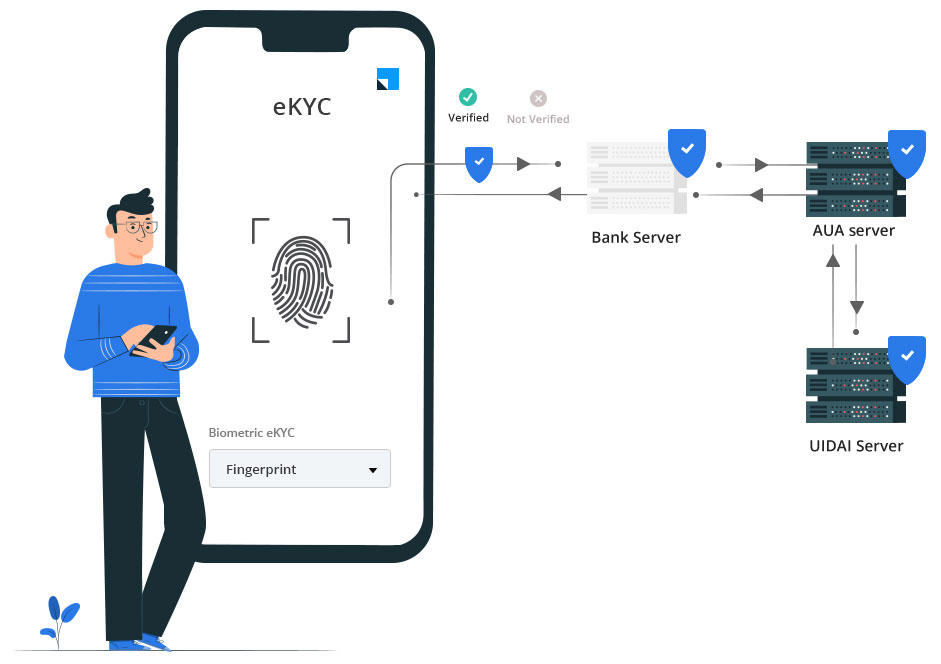
A user scans their fingerprint, instantly routing biometric data to a Bank Server that relays the request through an AUA server directly to the central UIDAI database.
One caveat worth separating out: performance after activation depends on where a provider routes traffic.
Many eSIM providers, especially global travel-SIM brands, operate as Mobile Virtual Network Operators (MVNOs) that lease network access rather than own towers or spectrum. When their servers sit in a different country from the user, that routing can add latency even though the phone is connected to a local tower.
It's a real factor in the user experience, but it has nothing to do with how well identity is verified. That distinction matters for the question this article is actually asking.
Combating Identity Fraud
According to the Global CFCA Telecom Fraud Report, subscription and identity fraud account for 35% to 40% of all telecom scams, with criminals using false or stolen identities to intercept verification messages and hijack financial accounts. eSIMs close off one attack vector entirely: an embedded chip is physically impossible to pull and reuse in another device.
eKYC is what makes the rest of the chain trustworthy.
For Aadhaar-based onboarding, a fingerprint scan is routed through an Authentication User Agency (AUA) server to the central UIDAI database for near-instant verification, replacing the judgment call of a human salesperson with a biometric match.
Where Aadhaar doesn't apply, customers submit a government ID (front and back) alongside a live selfie, which an automated check compares for authenticity and match quality.
Operators also capture the device's IMEI and the eSIM's unique eID during onboarding, giving them a way to re-verify both device and identity later if a sensitive transaction looks unusual. Travelers activating a plan before an international trip are generally advised to complete eKYC a few days early, in case a blurry document or a poor selfie forces a resubmission.
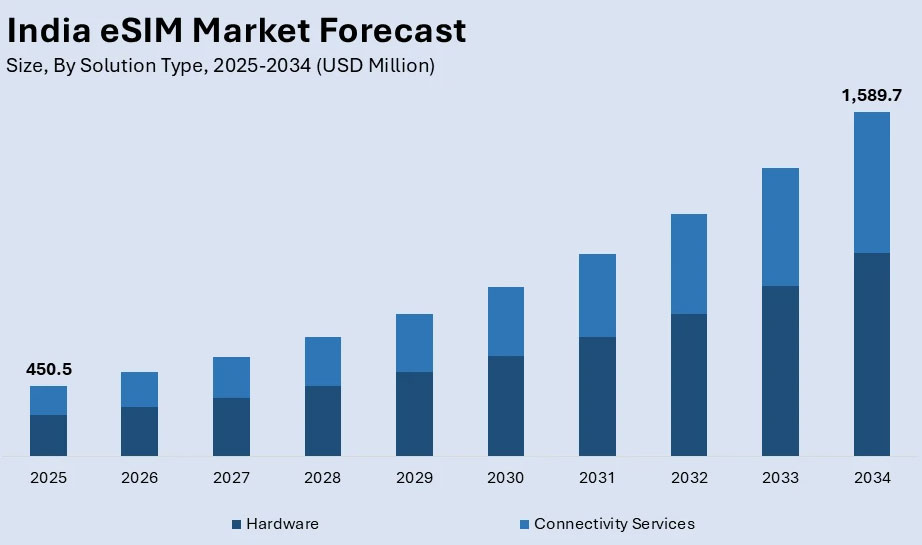
The 1,589.7 represents the total projected size of the India eSIM market in 2034, measured in USD million.
Regulatory Compliance at Scale
eKYC also does quieter, structural work: it's what lets operators comply with the General Data Protection Regulation (GDPR), anti-money laundering (AML) directives, and RBI, SEBI, and IRDAI guidelines without drowning in manual paperwork. That matters more, not less, as the market grows.
India's eSIM market alone is projected to reach roughly $1.59 billion by 2034, and every new subscriber added at that pace needs to clear the same compliance bar the first one did, in a fraction of the time a paper process would take.
Closing Remarks
So, can eKYC really keep up? At the front door, yes. Automated document checks, biometric authentication, and real-time database verification already onboard eSIM customers faster than any paper process could, and they do it while satisfying the same GDPR, AML, and RBI-grade compliance standards regulators expect from any financial-grade identity system.
The honest answer gets more interesting past the front door. The eSIM's convenience comes from removing physical friction, and every touchpoint that removes friction, device transfer, reactivation, roaming enrollment, is also a point where verification can quietly get lighter than it should be.
eKYC isn't struggling to keep up with eSIM adoption in India. It's being asked to extend the same rigor it applies at onboarding to a growing number of moments after onboarding, and that's the scaling problem operators and regulators still need to solve together.
Comments