The Light Dependent Resistor (LDR) sensor ranks as a widely used light-sensing component in electronics. Electronics students wire it into Arduino brightness monitors. Embedded systems engineers use it to trigger automatic street lighting. Hardware designers rely on it for backlight adjustment in kiosk displays and access control panels. The component generally works because it does one thing reliably. It changes its electrical resistance in response to ambient room light.
That reliability has a hard physical ceiling. The LDR sensor operates through photoconductivity - a process that typically takes tens of milliseconds to register a change in brightness. For a desk lamp circuit or a parking sensor, that response time appears acceptable. For a fingerprint scanner that must read the micro-fluctuations of living blood flow, it usually falls short. The gap between what an LDR sensor can measure and what human physiology actually produces is where physical spoofing attacks live.
Measuring What the LDR Sensor Cannot See
A standard LDR sensor like the GL5528 operates across a resistance range of roughly 1 kΩ in bright light to 10 MΩ in darkness. Its response time sits between 20 and 100 milliseconds, depending on illumination conditions. That range works well for slow ambient changes - a room dimming, a cloud passing. It usually fails at the sub-millisecond level where a heartbeat alters capillary blood volume and shifts light reflectance in living tissue.
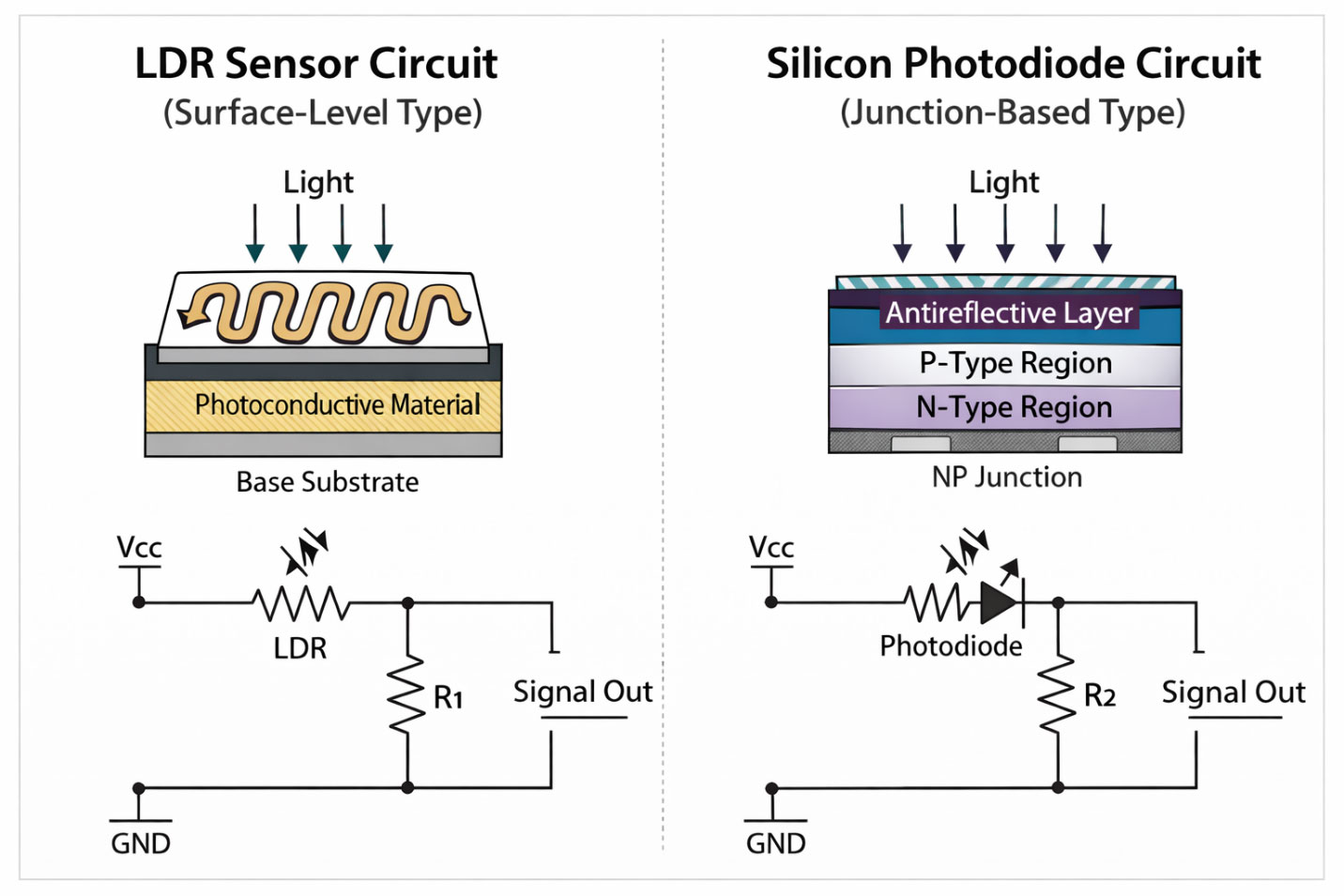
An LDR changes its electrical resistance based on ambient room light. Whereas, a photodiode converts light into an electrical current using a semiconductor junction.
This limitation does not constitute a design flaw in the LDR sensor. Engineers never designed it for physiological detection. The vulnerability emerged when early optical fingerprint scanners inherited ambient light-sensing architectures that designers never built for liveness verification.
In 2020, security researchers at Cisco Talos exposed exactly this weakness. They bypassed consumer biometric devices with an 80 percent success rate using cheap wood glue and 3D-printed silicone molds. The attack worked because those early scanners could not read anything beneath the skin surface. The LDR sensor gave the algorithms no subsurface data to work with.
This vulnerability forced hardware engineers to replace the LDR sensor with the silicon photodiode - a component that counts individual photons and often responds in nanoseconds. This hardware upgrade helps block many cheap physical spoofing attempts. It forces the attacker to fake complex human physiology rather than just copying a surface ridge pattern.
Comparing Sensor Response Times
To catch a replica, a multispectral fingerprint scanner must measure how light interacts with living tissue at a microsecond level. The legacy LDR sensor relies on photoconductivity. This process typically takes tens of milliseconds to register a brightness change. That latency often blinds the sensor to the rapid micro-fluctuations of human blood flow.
Conversely, a silicon photodiode counts individual photons. Depending on the system architecture, it can respond in nanoseconds. This precise sensor response time generally allows the firmware to perform biometric liveness testing accurately.
| Feature | LDR Sensor | Silicon Photodiode |
|---|---|---|
| Response Time | 20 to 100 milliseconds | Down to nanoseconds |
| PPG Pulse Detection | Often fails | Generally succeeds |
| Subsurface Penetration Depth | 0 millimeters (Surface only) | Up to 4 millimeters (Captures capillary beds) |
| Biometric PAD Support | Weak | Strong |
Building a Defense Framework
A fast photodiode does not stop presentation attacks alone. The component acts as the first checkpoint within a broader defense stack, capturing raw physical data. Next, firmware controllers and detection algorithms process that hardware signal to determine whether operational controls should grant access.
When a user places a finger on a multispectral sensor, the hardware executes several overlapping checks.
Reading the Surface Geometry
Initially, the optical array floods the finger with light. The image sensor reads the contrast between skin ridges and physical valleys. A printed replica often passes this basic optical check if the attacker copied the geometry accurately.
Analyzing Multispectral Tissue Absorption
Furthermore, the hardware fires light-emitting diodes across blue, green, and Near-Infrared (NIR) wavelengths. Living skin contains oxygenated hemoglobin and water. These specific molecules absorb NIR wavelengths at known rates. Synthetic materials return flat spectral curves. Consequently, the detection algorithms might flag the input because the infrared signal accuracy falls outside expected human parameters.
Tracking the Cardiac Cycle with PPG
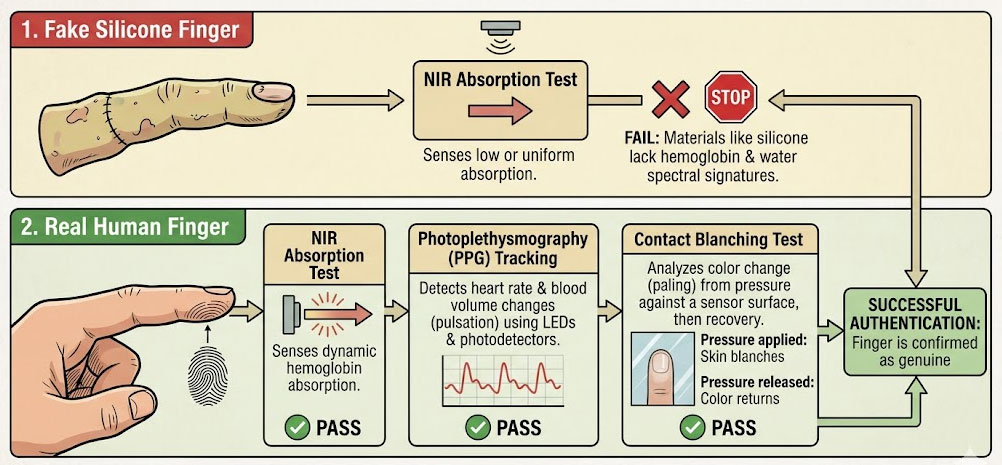
Next, the system measures Photoplethysmography (PPG). The PPG process tracks the cardiac cycle. Every heartbeat pushes blood into the capillaries. This action alters the blood volume and shifts light reflectance. The photodiode tracks these micro-fluctuations. The older LDR sensor fails here because it cannot track a waveform that fast.
Attackers sometimes attempt to bypass anti-spoofing checks by wearing a microscopic silicone mold over a live finger. They hope the NIR camera reads the live PPG pulse through the fake ridges. This physical approach forces an engineering compromise. If the attacker makes the mold thick enough to hide the polymer signature, the material blocks the PPG pulse. The attacker usually fails because they cannot satisfy both physical tolerances simultaneously.
If the attacker makes the silicone thin enough to transmit the pulse, the optical sensor reads the flat signature of the surface polymer.
Capturing Dynamic Contact Blanching
Subsequently, the hardware measures capillary reperfusion. Pressing a live finger against glass pushes blood away from the skin surface. The skin turns white. Releasing the pressure allows blood to rush back. The photodiode captures this transient brightness change rapidly. A static gelatin mold generally exhibits zero contact blanching.
Evaluating Attack Resistance with Error Rate Data
Security architects require verifiable data. The International Organization for Standardization (ISO) and the International Electrotechnical Commission (IEC) outline testing rules in the ISO/IEC 30107-3 standard for biometric PAD. Independent laboratories like iBeta Quality Assurance conduct Level 1 and Level 2 testing based on this framework.
To achieve a Level 2 compliance target, a biometric subsystem must block spoofing attempts that use 3D-printed resin, conductive latex, and thick silicone. Many enterprise specifications demand an Attack Presentation Classification Error Rate (APCER) of zero percent across hundreds of test attempts. The National Institute of Standards and Technology (NIST) applies similar thresholds in its Fingerprint Vendor Technology Evaluation (FpVTE) and Biometric Evaluation Datasets program to measure attack resistance. Upgrading the optical capture hardware to fast photodiodes generally helps vendors meet these strict laboratory limits.
Final Thoughts
Photodiodes capture precise physiological data. They do not eliminate all risk. They only secure the physical capture point. If an attacker compromises the communication bus between the image sensor and the main processor, they might inject synthetic data directly into the software layer. Under those specific conditions, the hardware upgrade means little.
Security architects should treat fingerprint sensor security as a multi-layered discipline. Multispectral sensors generally catch physical replicas like silicone and wood glue. They force attackers to abandon cheap spoofing methods.
Comments