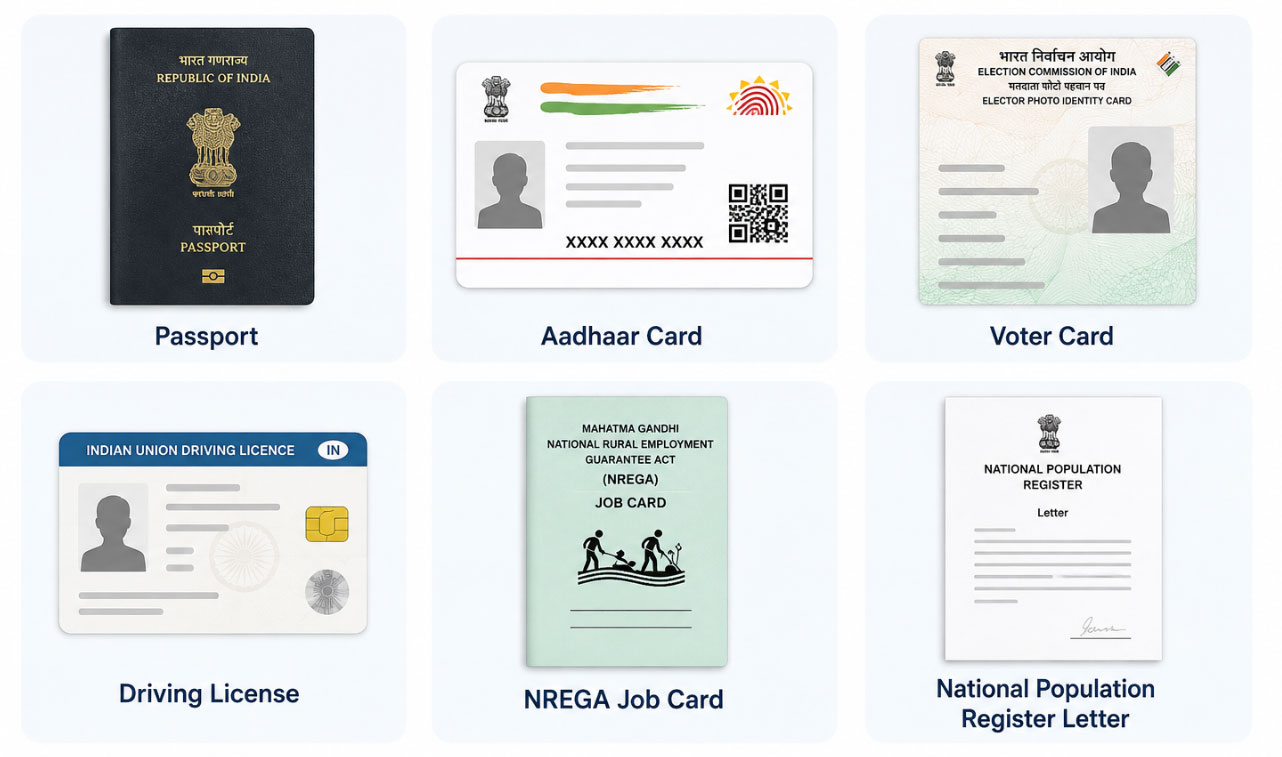
Bankers reject IDs every day not for a lack of authority, but for a lack of status. The Reserve Bank of India recognizes exactly six Officially Valid Documents (OVD) for KYC. Submit anything outside this list as your sole identity proof, and your application stalls.
The Prevention of Money-Laundering Act, 2002 keeps this list tight to stifle forgery. Clear verification with just one of the following.
Passport
The Indian passport anchors both identity and residence. Because it displays a printed address and undergoes police verification, banks treat it as the gold standard among OVDs.
Aadhaar
Banks process Aadhaar more than any other document. Biometric eKYC or a masked physical copy both offer instant authentication through UIDAI. Regulations require banks to mask the first eight digits of the Aadhaar number for privacy.
One clarification worth knowing: Aadhaar is not compulsory for general KYC. RBI's 2025 directions explicitly reiterate that a bank cannot insist on Aadhaar as the only acceptable OVD. The exception is narrow: if a customer wants to claim a benefit or subsidy under a scheme notified under Section 7 of the Aadhaar Act, 2016, that specific scheme can require it. Outside that, any one of the six OVDs works.
Voter's Identity Card
Issued by the Election Commission of India, the Voter ID ties a citizen to a specific constituency. It satisfies both identity and address requirements in one document.
Driving Licence
State Transport Authorities issue these with a photo and current address. It proves you can drive; for a bank, it proves you exist at a specific location.
NREGA Job Card
Signed by a State Government officer, this card gives rural workers a path into the formal banking system without needing a passport or driving licence.
National Population Register (NPR) Letter
Rare in practice, but a letter from the NPR containing name and address remains a valid OVD.
Confusion surrounds the PAN card. It sits in almost every KYC folder, yet the RBI does not classify it as an OVD.
Confusion surrounds the PAN card. It sits in almost every KYC folder, yet the RBI does not classify it as an OVD.
A PAN card proves identity but never proves address. Income tax law demands a PAN to track financial transactions, but the KYC framework excludes it from the OVD list. Submit a PAN to open an account if you like and the bank will still demand one of the six OVDs above to verify where you live.
Move to a new city, and your OVD address goes obsolete. Rather than forcing an immediate Passport or Aadhaar update, RBI allows "Deemed OVDs" to bridge the gap:
Utility Bills electricity, telephone, post-paid mobile, piped gas, or water, not older than two months.
Property Tax Receipts municipal tax receipts.
Pension Orders pension or family pension payment orders (PPOs) if they carry an address.
Employer Letters accommodation allotment letters from government departments, statutory bodies, PSUs, scheduled commercial banks, financial institutions, or listed companies, including leave-and-licence agreements tied to such allotments.
The rule stays simple: use a Deemed OVD for your current address, but a standard OVD still covers your identity.
The Restructuring Change
Here's the part most KYC explainers online still get wrong in 2026: the single, unified "RBI Master Direction on KYC" that governed this entire list no longer exists as one document.
On 28 November 2025, RBI folded roughly 3,500 directions and circulars into 238 consolidated Master Directions and withdrew 9,445 circulars in the same move.
The 2016 Master Direction on KYC which is the source document behind nearly every OVD explainer on the internet was repealed and replaced with ten sector-specific KYC Master Directions: separate instruments for commercial banks, NBFCs, payment banks, cooperative banks, and other regulated entity categories.
The six-OVD list itself did not change. What changed is where the rule lives.
A payment bank and a commercial bank now technically operate under different documents, and some provisions that applied uniformly under the 2016 framework like the Aadhaar OTP-based e-KYC loan ceiling do not carry over identically into every sector-specific version.
If you're citing "the RBI Master Direction on KYC" as a single source in 2026, name the relevant sector-specific direction instead, or your citation points to a repealed document.
DigiLocker and e-Aadhaar
Digital documents no longer sit in a legal grey area. RBI treats e-Aadhaar, m-Aadhaar, and documents pulled through DigiLocker as equivalent to physical originals, and REs can access DigiLocker-stored documents directly with customer consent.
Video-based Customer Identification Process (V-CIP) uses these digital OVDs to onboard customers in minutes, treated on par with face-to-face verification. The 2025 directions also loosened the liveness-check mechanics: facial gestures like blinking, smiling, or frowning are explicitly not mandatory for a liveness check, which gives REs more flexibility in how they build the verification flow and matters directly for anyone building V-CIP hardware or OCR pipelines, since it removes a rigid UX requirement that earlier implementations had to design around.
Comments