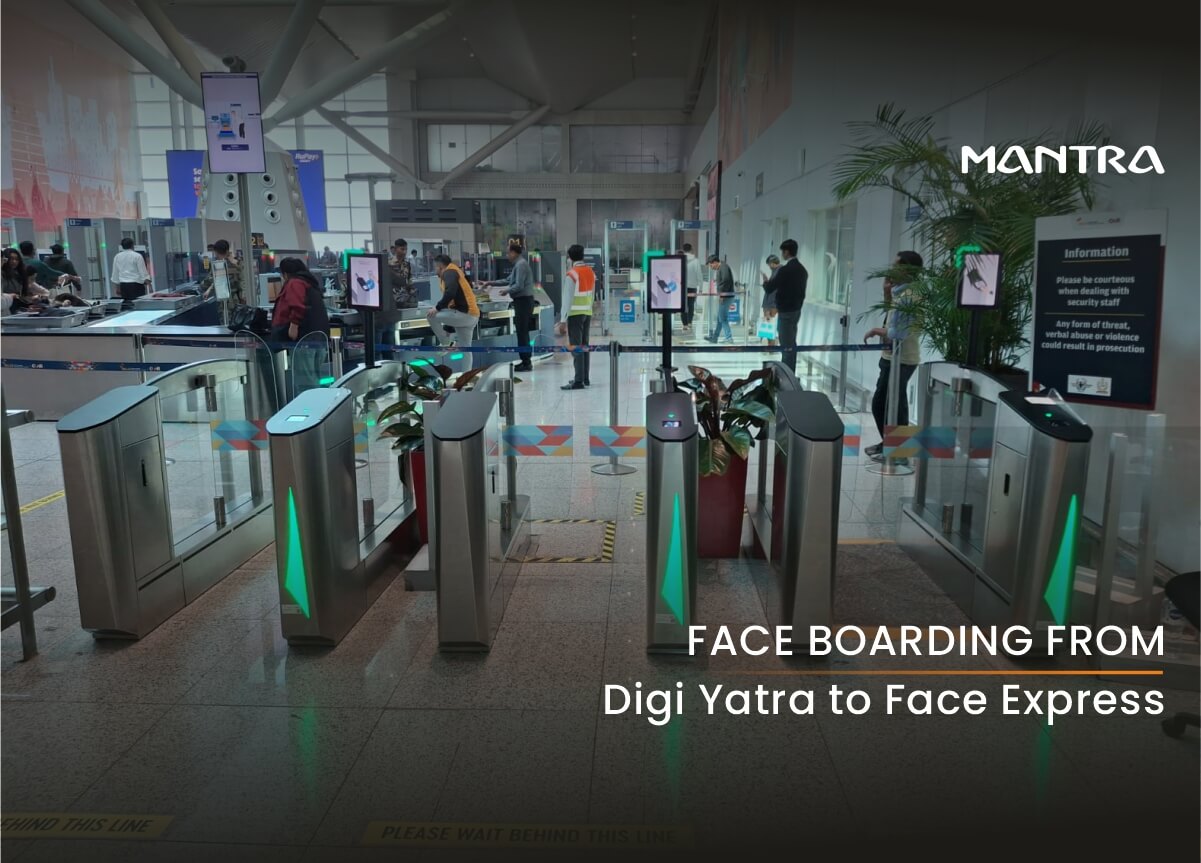
Airports across India, Japan, Europe, and the United States are replacing physical boarding passes and passport checks with FaceBoarding which is a facial recognition system that verify passengers without paper documents. India's Digi Yatra is now active at more than 30 airports. Japan's Face Express runs at Narita and Haneda. Major airports in New Delhi, Bengaluru, and Hyderabad are increasingly partnering with both domestic startups and international aviation technology firms like SITA, NEC, and Vision-Box.
FaceBoarding is expanding overall, but not uniformly, and its rollout has run into real regulatory limits in Europe even as adoption grows elsewhere. From India to Japan and across Europe, "FaceBoarding" is becoming the standard for air travel.
What is FaceBoarding?
FaceBoarding is an airport process that verifies a passenger's identity and flight details using facial recognition instead of a physical passport and boarding pass. A passenger looks into a camera at terminal entry, security, or the boarding gate. The camera captures the face, converts it into a mathematical template, and matches it against a profile the passenger registered in advance or on arrival. A match opens the gate automatically.
The name FaceBoarding originated as the branded system SEA Milan Airports launched at Milan Linate in 2024, built with Thales, Dormakaba, ENAC, and the Italian State Police. The term is now used more broadly for facial recognition boarding systems generally, including India's Digi Yatra and Japan's Face Express though the original Milan Linate program is currently suspended.
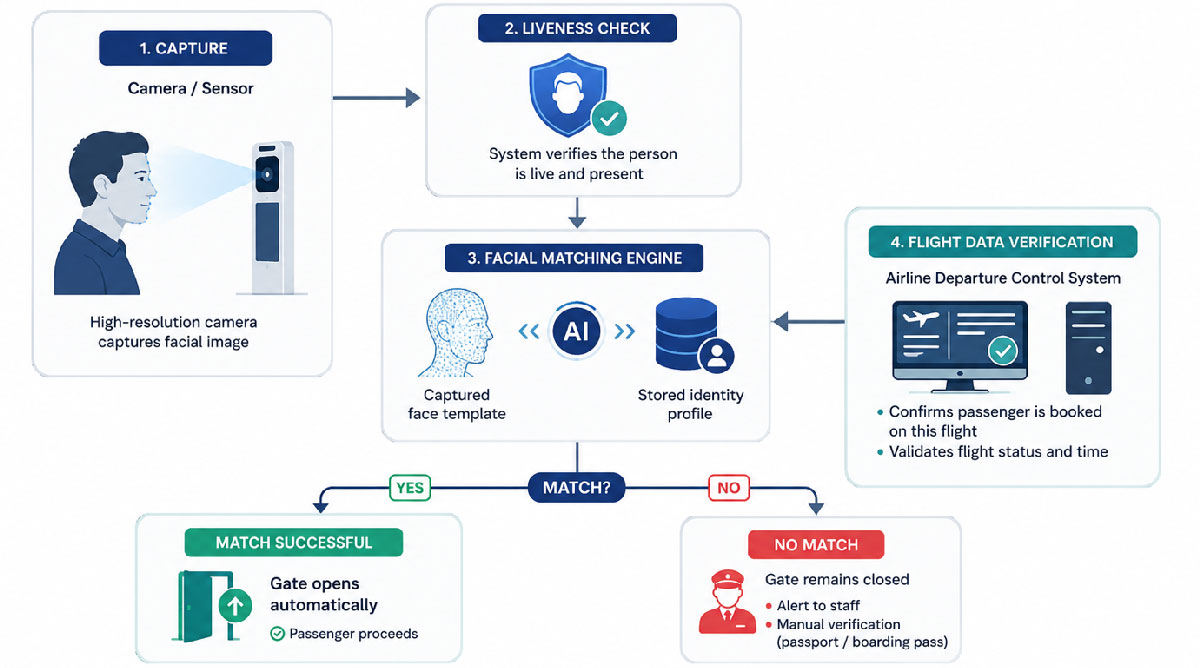
How Faceboarding Turns Face Capture to Gate Access in Seconds.
The systems generally rely on three components: a camera or sensor capable of capturing a usable facial image, matching software that compares the capture against a stored template, and a data link to the airline's departure control system so the gate can confirm the passenger is booked on that flight. Most current FaceBoarding systems also include liveness detection, which checks that the camera is scanning a live person rather than a photo or video, to prevent impersonation.
e-Passports (Biometric Passports)
International FaceBoarding depends on e-passports. An e-passport contains an embedded RFID microchip storing the holder's personal data and a digital facial image formatted to International Civil Aviation Organization (ICAO) standards.
During registration, an NFC-enabled smartphone or airport kiosk reads the chip and compares the passenger's live facial scan against the cryptographically signed data it contains. This matches the person registering against the identity the passport-issuing government has verified, which is why e-passports are a prerequisite for cross-border FaceBoarding rather than domestic-only systems.
Digi Yatra vs. Face Express
Digi Yatra works through a mobile app. Passengers register in advance, verifying identity through Aadhaar or DigiLocker and uploading their boarding pass before arriving at the airport. Biometric data is stored on the passenger's own device and shared with the airport only with consent at each checkpoint. As of early 2026, it is live at more than 30 airports; cumulative passenger-journey figures vary by source (reports range from roughly 6.1 crore to over 8.5 crore since the December 2022 launch), and the Ministry of Civil Aviation has not published a single reconciled total.
Face Express works through on-site enrollment. Passengers arriving at Narita or Haneda go to a kiosk, scan their passport and boarding pass, and take a photo as no prior app download required. Built on NEC's biometric engine, it creates the identity token at the terminal and, like Digi Yatra, deletes it within 24 hours of the flight.
Where FaceBoarding Stands Globally
Singapore's Changi Airport completed passport-less clearance across all four terminals on September 30, 2024, using combined facial and iris recognition under the Immigration and Checkpoints Authority's New Clearance Concept.
By the ICA's own count, close to 127 million travelers cleared immigration at Singapore's checkpoints without producing a passport in 2025 alone, with average clearance time cut from 25 seconds to 10.
In 2026, Singapore formalized this lead by joining Malaysia, Thailand, Indonesia, and the Philippines in the Safe Skies Initiative, a regional push to standardize biometric border infrastructure across ASEAN, though the initiative itself notes the five countries remain at different levels of maturity, with Thailand running facial recognition at six major airports and Malaysia still operating a hybrid model of e-passports, selective facial capture, and QR-based workflows at Kuala Lumpur.
The United States is expanding on a different track. Customs and Border Protection's Biometric Exit program checks departing travelers against flight manifests and passport or visa photos already on file. It is growing, but it answers a different question: confirming a traveler is who their government records say they are, rather than speeding up an airline's own boarding process.
The airports moving fastest share one trait the suspended and discontinued programs didn't: data stays close to the passenger, gets deleted quickly, and the airport's public claims about both have so far matched what regulators found when they checked.
Comments