Face spoofing attacks such as printed photos, replay videos, and silicone masks can easily bypass traditional facial recognition systems. To stop these attacks, modern biometric systems increasingly rely on IR camera liveness detection, which analyzes how human skin responds to near-infrared light. In the industry, this is known as Presentation Attack Detection (PAD).
Meanwhile, an IR (Infrared) camera is an imaging device that captures information from wavelengths outside the visible spectrum. Unlike conventional cameras that operate primarily between 400 and 700 nanometers, IR cameras detect infrared radiation, allowing them to reveal details that human eyes cannot see.
While there are four distinct IR subtypes, biometric hardware relies almost exclusively on the Near-Infrared (NIR) band because NIR wavelengths can easily penetrate standard smartphone glass and are natively compatible with cost-effective CMOS image sensors.
| Type | Wavelength | Primary use |
|---|---|---|
| Near-Infrared (NIR) | 700-1400 nm | Biometric liveness detection |
| Short-Wave IR (SWIR) | 1400-3000 nm | Industrial inspection |
| Mid-Wave IR (MWIR) | 3000-5000 nm | High-temperature sensing |
| Thermal IR (LWIR) | 8000-14000 nm | Medical thermography |
For biometric liveness detection, Near-Infrared cameras operating around 850 nm and 940 nm are most commonly used.
Why a Standard RGB Camera Cannot Spot a Fake?
When a facial recognition system is fooled by a printout or a screen, the root cause is spectral, not algorithmic. All these physical attacks operate in the same 400 to 700 nm visible band the camera already captures. A printer, a screen, and painted silicone each reproduce human skin color convincingly.
The key limitation is not the facial recognition algorithm itself. A standard color camera provides only a single optical data channel - visible light. Since spoof artifacts are designed to look convincing within that same wavelength range, the system lacks an independent signal to verify whether the observed face is genuine human tissue or an artificial presentation attack.
Without this secondary optical channel, systems cannot effectively lower their False Acceptance Rate (FAR) for spoofing without heavily degrading the user experience and increasing the False Rejection Rate (FRR). Because a standard color sensor feeds the algorithm only one data channel - visible light - the camera has nothing else to check.
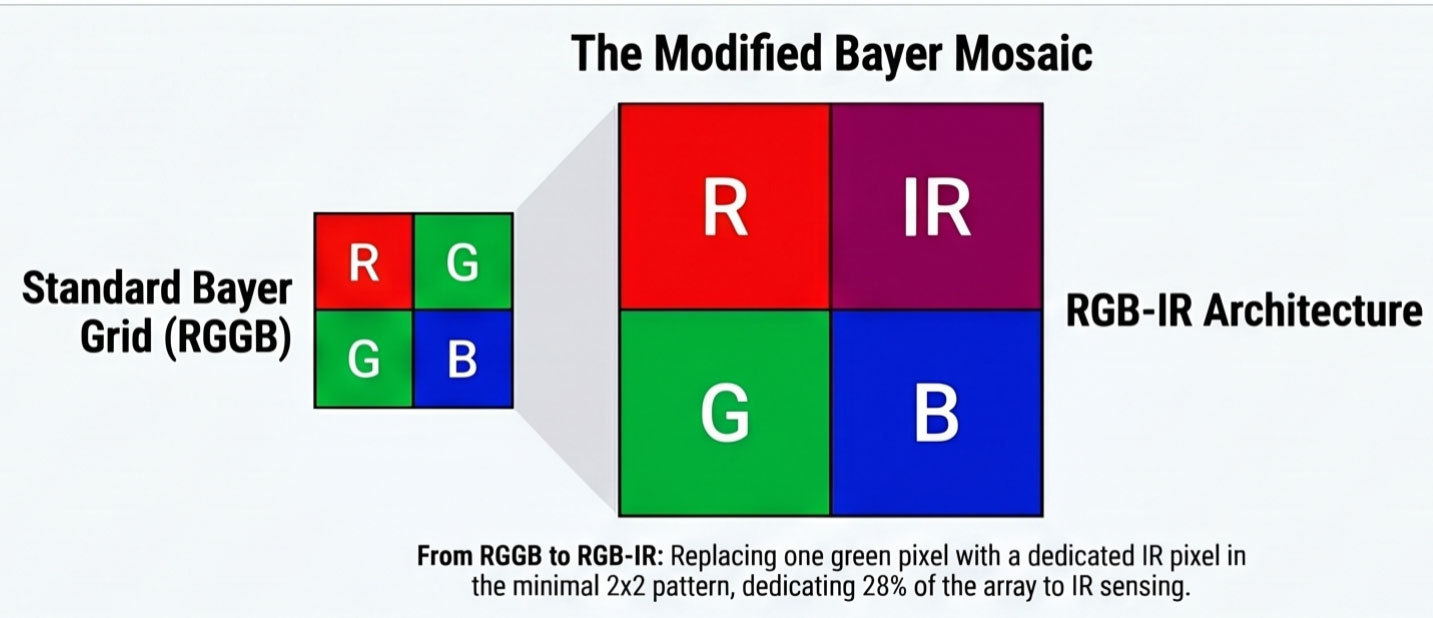
The sensor architecture that makes dual-channel capture possible is the RGB-IR mosaic.
The core mechanism behind IR liveness detection is subsurface scattering. When near-infrared light hits a genuine human face, it penetrates the skin by 2 to 3 millimeters, absorbing into hemoglobin and scattering off blood vessels before reflecting back to the sensor. Artificial materials like paper, silicone, and digital screens completely lack this biological subsurface scatter.
An active NIR illuminator - either an 850 nm or 940 nm LED - floods the face with infrared light, providing high-security active illumination while maintaining a frictionless, passive liveness experience for the user. What happens next depends entirely on what the light hits:
| Material | Visible (RGB) Response | Near-Infrared (NIR) Response |
|---|---|---|
| Living skin | Natural tones | Visible vascular patterns due to subsurface scatter |
| Paper print | Convincing color | Flat paper fibers scatter light evenly |
| OLED/LCD screen | Accurate color | Moiré patterns from pixel grids |
| Silicone mask | Mimics skin tone | Zero subsurface scatter |
Manufacturers like Sony (IMX series) and OmniVision (OV series) replace one green pixel in each 2X2 Bayer cluster with an infrared-sensitive pixel on a single CMOS sensor. The remaining three pixels reconstruct a standard RGB frame. A single sensor simultaneously delivers one image for identity matching and one for liveness analysis.
The Engineering Trade-offs No Vendor Brochure Mentions
Optical resolution cost
An RGB-IR sensor dedicates roughly 25% of its pixel budget to the IR channel. Replacing one green pixel per cluster means the RGB image must be reconstructed through more aggressive demosaicing and interpolation. The tradeoff: richer liveness data at some cost to color fidelity. Engineers choose confocal day-night lenses to bring both wavelength bands into focus on the same plane, since visible and NIR light refract at different angles.
Infrared leakage and color contamination
NIR energy can partially penetrate the visible-light filter stack and contaminate RGB pixels. Without correction, this produces a pink or magenta cast in the visible image. Manufacturers compensate with dual band-pass optical filters or mechanical IR-cut filters (ICR switches), alongside computational correction but aggressive correction increases image noise. Every production deployment involves tuning this balance.
Outdoor solar interference
Sunlight contains broadband NIR energy. Outdoors, that ambient radiation can overwhelm the reflected signal from the active illuminator. The engineering response involves synchronized illumination pulses (often utilizing VCSELs - Vertical-Cavity Surface-Emitting Lasers), optical band-pass filters, and adaptive exposure algorithms. Outdoor deployments are significantly more complex than indoor fixed installations.
850 nm vs 940 nm: The Decision That Shapes Your Deployment
850 nm delivers a stronger signal-to-noise ratio but emits a faint, visible red glow. This is the dominant choice for indoor fixed installations like access control terminals.
Whereas, 940 nm avoids the visible "red burst" entirely by sitting near a water absorption peak in the spectrum. It is completely invisible to the human eye, making it ideal for mobile biometric authentication (and is the wavelength utilized by systems like Apple's FaceID). However, it requires higher drive current, taxing portable device batteries.
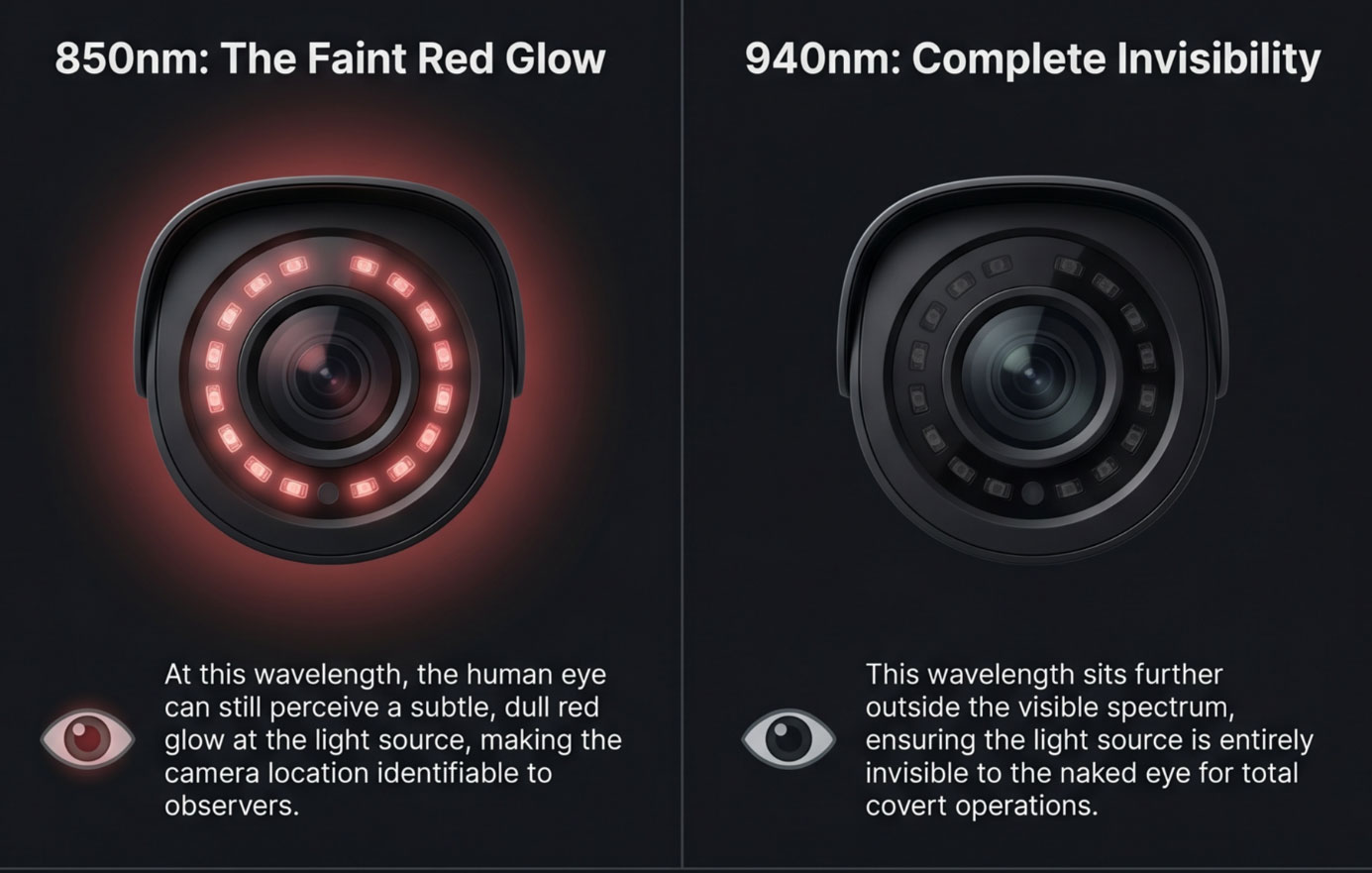
The closer the wavelength is to visible red light, the more likely humans are to notice a faint glow.
Specifying "IR camera" in a tender document without specifying the wavelength is a common error. A vendor can supply an 850 nm or 940 nm system - both qualify as IR cameras, but the operational behavior in your deployment environment will differ significantly.
The IR Camera Collects Evidence & Software Makes the Call
"An IR camera does not detect spoof attacks. It collects richer optical evidence that a machine-learning model then interprets. The camera provides the data; the algorithm provides the verdict."
After image acquisition, the image signal processor separates the raw RGB-IR mosaic into two synchronized streams: a conventional RGB image for identity matching and a dedicated IR image for material analysis. Because both frames are captured simultaneously from the same sensor, every facial region can be cross-examined across two wavelength bands.
Modern liveness detection models - typically powered by Convolutional Neural Networks (CNNs) or Vision Transformers - are trained on thousands of synchronized RGB-NIR pairs, learning to recognize the spectral fingerprints of living tissue versus spoof materials. The output is a liveness confidence score - a probability estimate that the face belongs to a physically present person, not a manufactured presentation.
When paired with enterprise-grade sensors, these algorithms regularly pass independent iBeta Level 1 and Level 2 PAD testing.
Comments