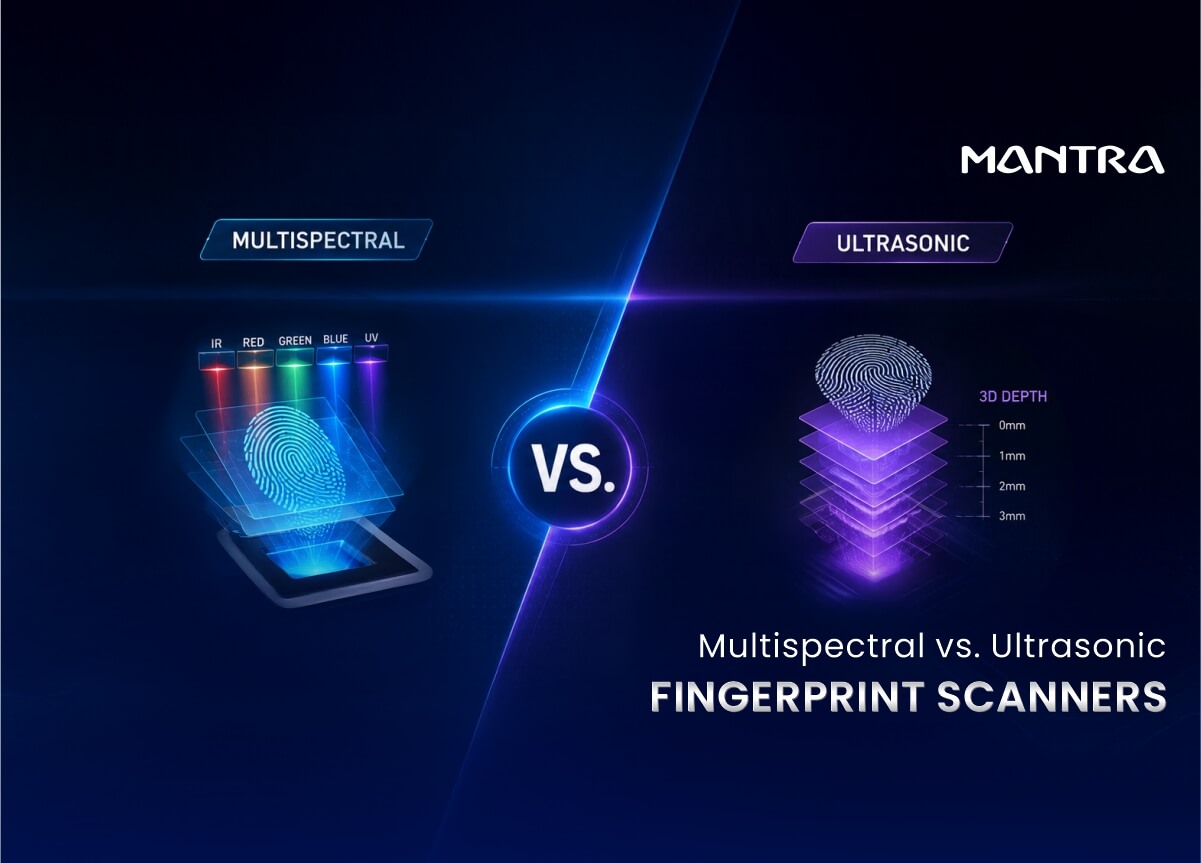
A multispectral fingerprint scanner uses multiple wavelengths of light to image both the surface ridges and the subdermal capillary layout of a finger. An ultrasonic fingerprint scanner uses high-frequency sound waves to build a 3D map of the ridges and valleys on the surface of the skin. This article breaks down how each sensor works, where each is used, and which one to pick for a given deployment.
What Is a Multispectral Fingerprint Sensor?
A multispectral fingerprint sensor is an optical sensor that captures fingerprint data using several light wavelengths instead of a single light source. The different wavelengths penetrate the skin to different depths. Visible light captures the surface ridge pattern; near-infrared light penetrates into the dermis and picks up capillary structure and blood flow beneath the skin. A CMOS image sensor captures both layers, and onboard software fuses them into a single fingerprint image.
Because part of what a multispectral sensor reads comes from beneath the skin, it can still produce a usable match when the surface print is degraded, from dirt, moisture, dry skin, or minor cuts and calluses. This is the main reason multispectral sensors are used in industrial and outdoor access-control hardware, where fingers are frequently unclean.
What Is an Ultrasonic Fingerprint Sensor?
An ultrasonic fingerprint sensor is an acoustic sensor that emits high-frequency sound waves through a piezoelectric transducer and measures how those waves reflect off the finger. Ridges, which contact the sensor surface, and valleys, which contain air gaps, reflect sound differently. The sensor converts the timing and intensity of the returning waves into a 3D map of the fingerprint surface, including ridge depth and, on higher-end implementations, some pore-level detail.
Because sound transmits through solid material, an ultrasonic sensor can sit underneath a glass display or a metal chassis without a physical opening. That property is why ultrasonic sensors are the standard for under-display fingerprint unlock in premium smartphones, Samsung has used ultrasonic in-display sensors since the Galaxy S10, and Qualcomm's 3D Sonic sensor line is the component most commonly licensed for this purpose.
Multispectral vs. Ultrasonic: Core Technical Differences
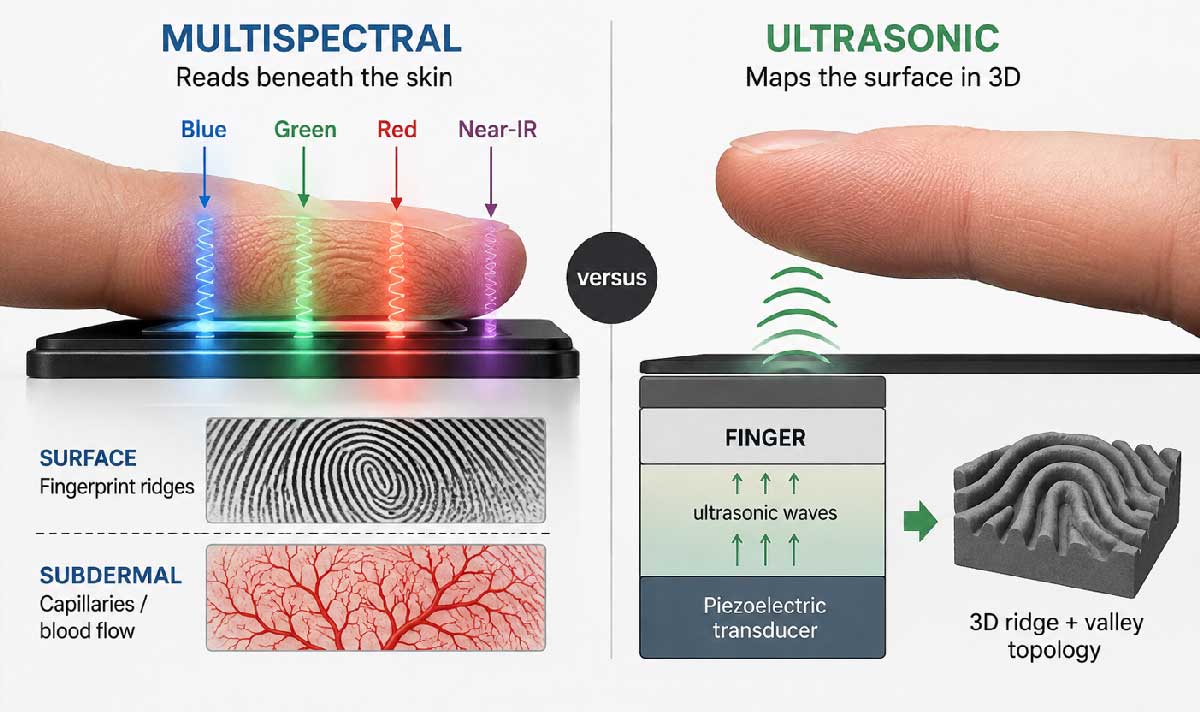
A multispectral scanner captures fingerprint details using multiple wavelengths of light, while an ultrasonic scanner uses sound waves to create a 3D map of the finger's surface.
| Feature | Multispectral Scanner | Ultrasonic Scanner |
|---|---|---|
| Underlying technology | Multi-wavelength optical imaging (visible + near-infrared light) | Acoustic sensing via piezoelectric transducer |
| What it captures | Surface ridges plus subdermal capillary structure | 3D surface topology of ridges, valleys, and pores |
| Sensor footprint | Larger as it requires multiple LEDs, light guides, and a lens stack | Thin as it can be embedded under glass or metal |
| Typical placement | Standalone terminal or door-access hardware | Under smartphone displays or chassis |
| Performance on damaged/dirty skin | Strong as the subsurface data compensates for surface damage | Moderate as the surface-dependent, though unaffected by moisture |
| Anti-spoofing basis | Subsurface tissue and blood-flow pattern | Acoustic density and structural depth of the print |
| Typical deployment | Enterprise access control, border checkpoints, banking kiosks | Consumer smartphones, laptops |
Which Fingerprint Scanner Is More Secure?
Both multispectral and ultrasonic sensors resist spoofing far better than basic optical or capacitive sensors, because both capture data beyond the flat 2D surface image that a printed or molded fake can replicate.
An ultrasonic scanner detects spoofs by measuring acoustic density and structural depth i.e. a silicone or gelatin mold reflects sound differently than living tissue, so a well-tuned system flags density mismatches. A multispectral scanner detects spoofs by reading subdermal blood-flow patterns, which are effectively impossible to replicate in a synthetic material with current fabrication methods.
Neither claim should be read as absolute. Spoof resistance in both cases depends on sensor calibration, algorithm quality, and how aggressively the manufacturer tunes the balance between false rejection rate (FRR) and false acceptance rate (FAR). A poorly tuned sensor of either type can be beaten; a well-tuned one of either type is difficult to beat with current spoofing techniques.
Which Works Better on Wet, Dirty, or Damaged Fingers?
Ultrasonic sensors tolerate moisture well, because sound waves pass through water and are not disrupted by it the way electrical capacitance sensing is. Multispectral sensors tolerate dirt, calluses, and minor cuts well, because the near-infrared component reads structure beneath the damaged or obscured surface layer rather than relying on it.
In practice, multispectral sensors have the wider environmental tolerance overall, which is why they're the default choice for industrial, outdoor, and law-enforcement hardware rather than for consumer smartphones i.e. the anticipated finger condition is worse and more variable in those settings.
Usage of Sensors
Ultrasonic scanners are built into consumer electronics:
Primarily premium and mid-range smartphones because their thin profile and ability to work through glass make in-display, bezel-free unlock possible.
Not used in enterprise or government access-control hardware, where the larger, standalone form factor of a multispectral unit isn't a constraint.
Multispectral scanners are built into standalone hardware:
Used in physical access-control terminals, time-and-attendance systems, border-control kiosks, and financial-institution authentication devices.
Larger footprint and higher power draw make them impractical for handheld consumer devices, but irrelevant in fixed installations where reliability across dirty, wet, or injured fingers matters more than size.
Cost and Integration
Multispectral sensors cost more to manufacture and integrate because of the optical component count which has multiple LED wavelengths, light guides, filters, and a dedicated image-fusion processor.
Ultrasonic sensors cost less at the module level but require precise acoustic coupling during assembly; any air gap or adhesive inconsistency between the sensor and the mounting surface, including a poorly applied screen protector that degrades or fails the reading. This is a documented cause of unlock failures on ultrasonic-equipped phones after screen protector installation.
Which Fingerprint Scanner Should You Choose?
Ultrasonic is the standard choice when building or buying a smartphone/consumer device with an in-display sensor.
Multispectral is the stronger choice when building or buying access-control hardware for an industrial, outdoor, or high-traffic environment.
For security requirement is at the highest tier (border control, banking infrastructure), choose multispectral, because subsurface liveness detection is harder to defeat and the larger form factor isn't a constraint in fixed installations.
Choose ultrasonic where budget and thin form factor are the primary constraints, given its lower module cost and ability to embed under existing surfaces.
Comments