
The U.S. National Institute of Standards and Technology (NIST) has released a fully annotated version of Special Database 302 (SD 302), a collection of 10,000 latent fingerprint images used in forensic and biometric research. Alongside it, NIST made public OpenLQM, an open-source release of a fingerprint quality-assessment tool previously restricted to U.S. law enforcement.
NIST announced both on March 23, 2026, alongside NIST Technical Note 2367, "Annotated Latent Distal Phalanxes," authored by a team from NIST's Information Access Division together with Schwarz Forensic Enterprises.
What Changed in SD 302
SD 302 was originally collected under a joint NIST and Intelligence Advanced Research Projects Activity (IARPA) project known as the Nail-to-Nail Fingerprint Challenge, and first released in December 2019. It consists of 10,000 latent fingerprint images from 200 volunteers, gathered by having participants handle everyday objects and lifting the prints left behind using techniques standard in crime scene investigation.
The dataset has been updated several times since 2019. An interim release in November 2021 carried annotations for about half of the 10,000 images. NIST has now completed annotation of the full set.
According to the TN 2367 abstract, NIST worked with certified latent print examiners to annotate the images with minutiae, orientation, and ridge quality maps, and to determine each print's ground truth finger position. SD 302 is distributed as nine component datasets (SD 302a through SD 302i), covering different print types and capture methods.
What OpenLQM Does
OpenLQM is a newly open-sourced version of LQMetric, a fingerprint quality-assessment tool originally developed between 2012 and 2014 by federal research body Noblis, funded by the FBI's Criminal Justice Information Services Division. LQMetric's output is not a general "usable detail" score according to a 2020 Noblis research paper, it estimates the probability that an image-only search of the FBI's Next Generation Identification AFIS would return a correct match at rank 1, if the subject's exemplar prints are already enrolled in that system.
LQMetric's use was previously limited to U.S. law enforcement. Over the past year, NIST funded its conversion into a cross-platform tool that runs on Windows, Mac, and Linux, and published it as open-source software, OpenLQM, available directly through NIST's fingerprint research portal on GitHub.
According to NIST computer scientist Gregory Fiumara, the tool is meant to help examiners prioritize evidence with the highest chance of yielding a usable result. "You give OpenLQM a fingerprint and it returns a number from 0-100 that is an assessment of the print's quality," Fiumara said. "It can help print assessors work more quickly, which is important in forensic science when you often have hundreds of prints to review from a crime scene. You want to help them separate out the prints that contain the highest level of detail."
OpenLQM vs. NFIQ 2
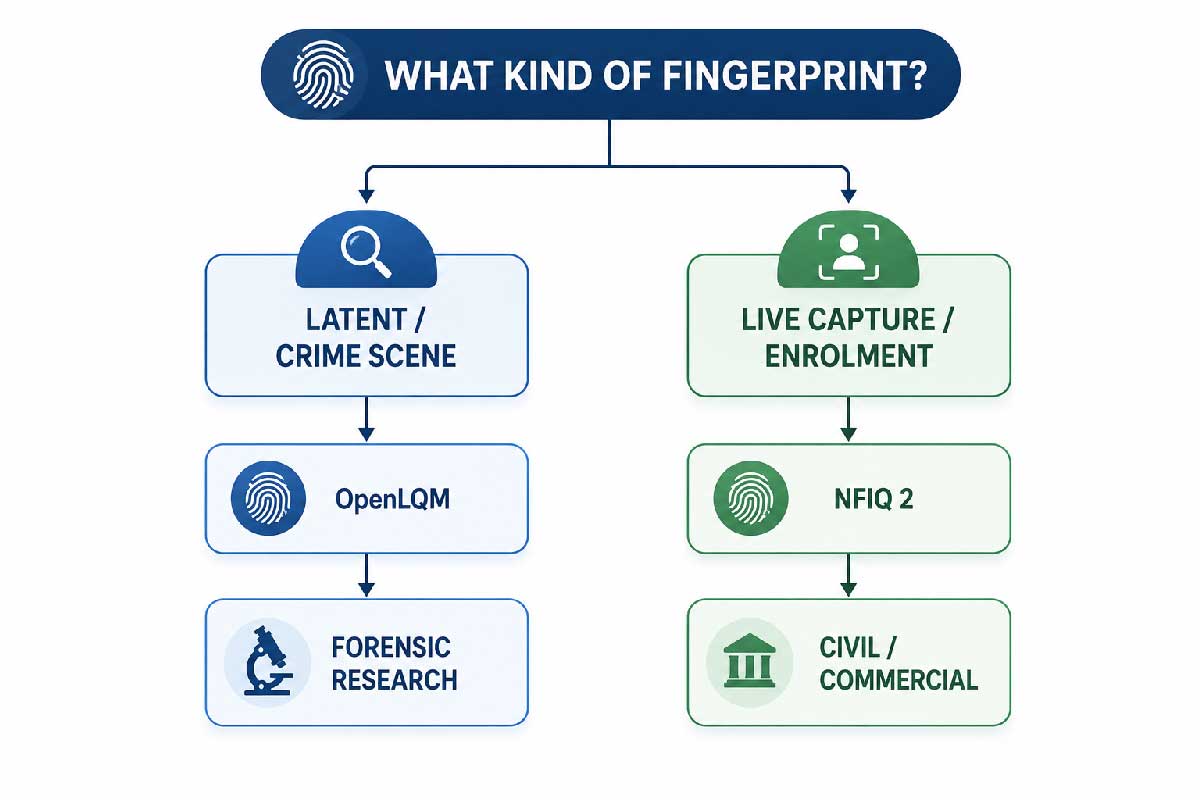
OpenLQM should not be confused with NFIQ 2, NIST's general-purpose framework for assessing fingerprint image quality in biometric recognition workflows, developed jointly with Germany's Federal Office for Information Security (BSI).
NFIQ 2 is built around live-captured fingerprints used in recognition and enrollment systems. OpenLQM was developed specifically around the characteristics of latent fingerprints recovered at crime scenes, and its score is tied to match probability against a criminal-identification AFIS specifically not to enrollment or verification workflows in civil or commercial biometric deployments.
According to NIST, SD 302 has been downloaded by more than 1,000 research organizations across more than 90 countries since its original release.
Anthony Koertner, a certified latent print examiner at the U.S. Army Criminal Investigation Division's Criminal Investigation Laboratory, said the SD 302 annotation and the OpenLQM release together represent "a significant advancement for the global forensic community," and that they have supported his department's "efforts to achieve greater objectivity and reproducibility in latent print quality assessments."
Fingerprint examiners routinely work with partial, smudged, or otherwise degraded prints lifted from real-world surfaces, not the clean, high-contrast scans used in enrollment systems. Fiumara said the annotated dataset is intended to teach both new examiners and machine learning systems what to look for: "These images are good for classroom education, to teach examiners how to look for identifying features. And they will also help teach AI algorithms where to look and how to weigh a feature's importance."
What NIST's New Dataset Means for AFIS and Anti-Spoofing Systems
An Automated Fingerprint Identification System (AFIS) compares fingerprints against large databases using features such as ridge endings and bifurcations. NIST's completed SD 302 annotations provide verified locations of these features, along with orientation, ridge quality and finger-position data.
This gives researchers a larger labelled dataset for training and testing systems that process partial, smudged and degraded latent fingerprints. Its direct relevance is therefore to latent fingerprint analysis and forensic AFIS research, rather than standard fingerprint enrollment.
The connection to anti-spoofing is different. SD 302 is not a Presentation Attack Detection (PAD) dataset and does not contain silicone, gelatin or other spoof fingerprints.
PAD systems instead determine whether a biometric sample is genuine or fraudulent. For example, ASIM (Anti-Spoofing Intelligence Multi-Biometric) by Mantra Softech is designed to detect and block presentation attacks across face, fingerprint, iris and voice verification.
OpenLQM and SD 302 assess the quality and characteristics of latent fingerprints. PAD platforms such as ASIM assess whether the biometric sample itself is genuine.
Comments