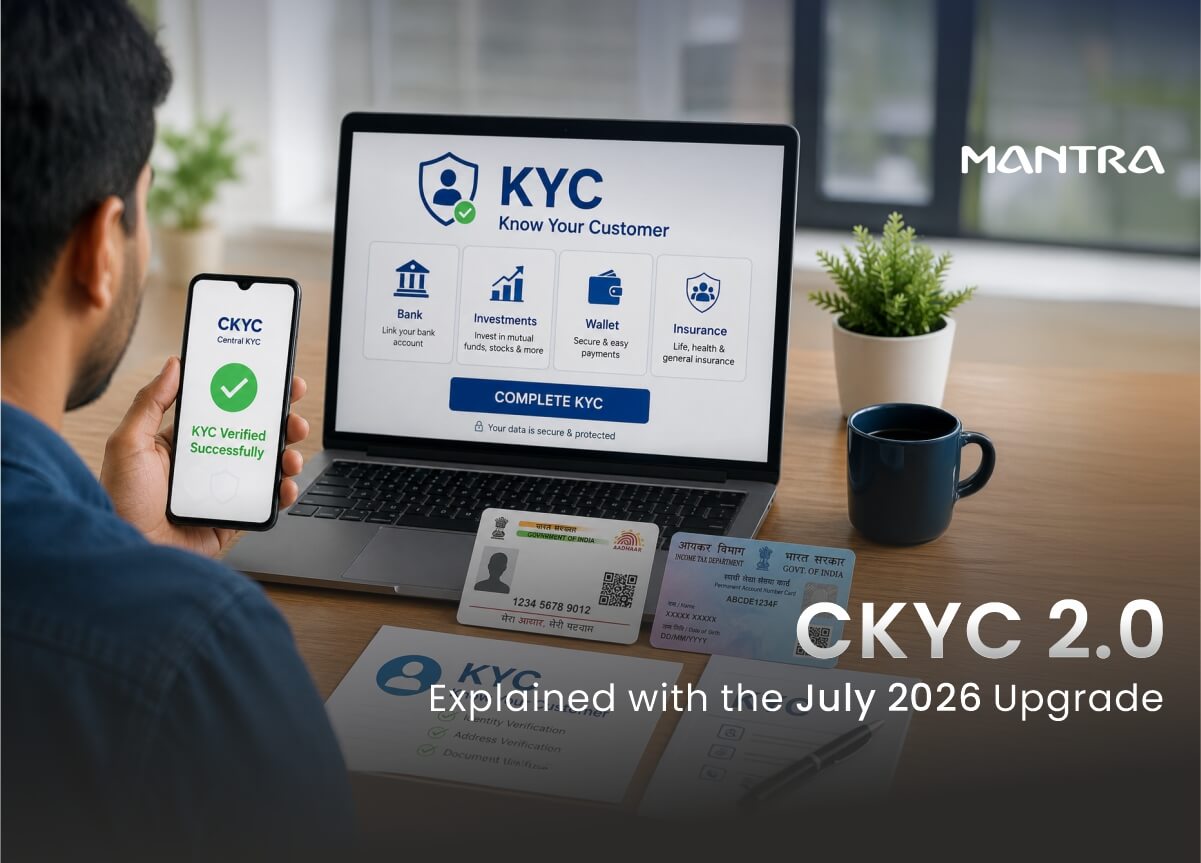
India's Central KYC system is being upgraded. Banks, insurance companies and other financial institutions are moving to a new version of the registry that stores every Indian's verified identity document, called CKYC 2.0.
CKYC stands for Central Know Your Customer. It is a single national registry where a person's identity documents, PAN, Aadhaar, passport, address proof, are verified once and stored centrally.
Once that verification is done, the customer receives a 14-digit CKYC number, also called a KIN. Any bank, insurer, mutual fund or NBFC that needs to confirm the customer's identity can pull that record from the registry instead of asking the person to submit the same documents all over again.
The registry is run by CERSAI, the Central Registry of Securitisation Asset Reconstruction and Security Interest of India, on behalf of the country's financial regulators. It was built to end a genuine problem: a customer opening a bank account, then buying insurance, then investing in a mutual fund, used to have to prove their identity from scratch each time, even though every institution was checking the same documents.
eKYC is simply a way of verifying someone's identity electronically, usually through Aadhaar and an OTP or a biometric match. It can be used for one product or many. CKYC is the registry itself, the permanent record that stores the outcome of that verification so any participating institution can reuse it later, without repeating the process.
What is CKYC 2.0?
The old system, now referred to as CKYC 1.0, has struggled with the basics. Records have gone missing, duplicated or gone out of date, and institutions have often found it easier to just redo a customer's KYC than trust what was already sitting in the registry. That defeated the entire point of having a central registry in the first place.
CKYC 2.0 is CERSAI's attempt to fix that. It is not a new idea layered on top of the old one. It is a full platform rebuild, with better data checks, clearer rules for institutions, and new tools to manage customer records properly instead of letting them go stale.
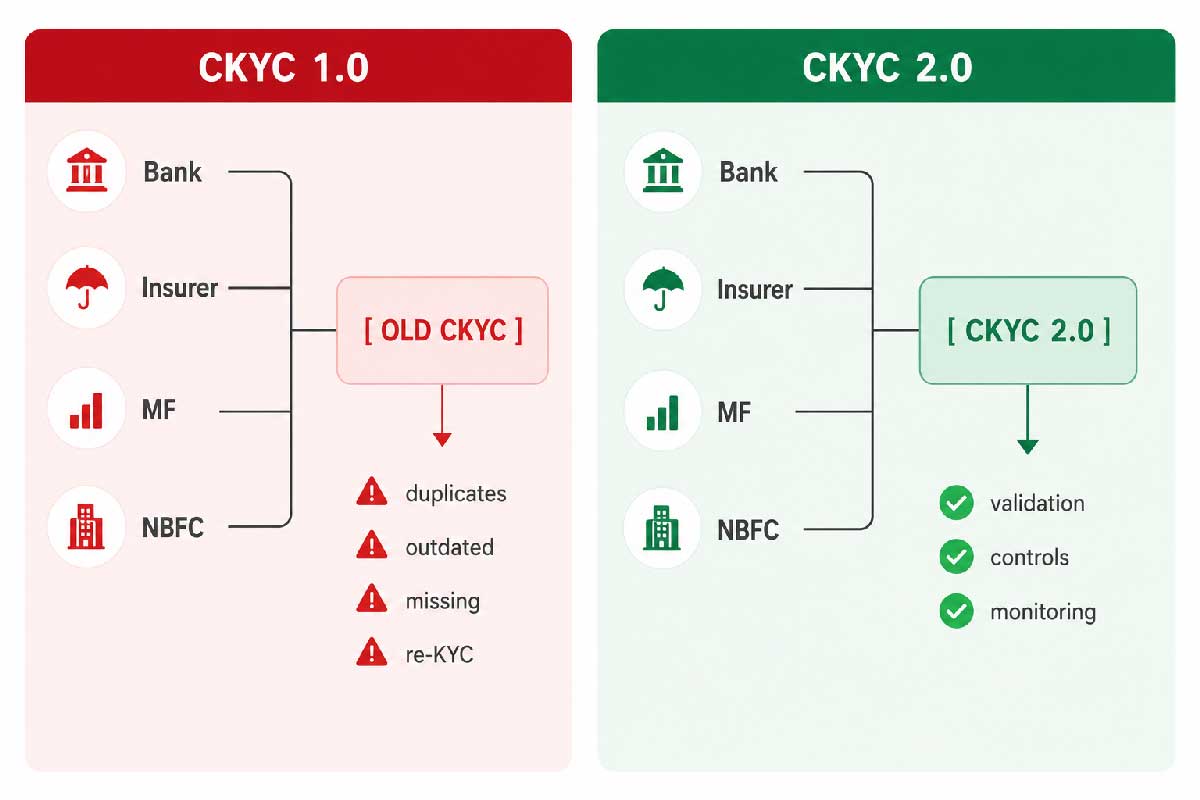
CKYC 2.0 is the upgraded version of India's Central KYC registry, rebuilt by CERSAI to fix long-standing problems with outdated, duplicate and poorly managed records, and to give institutions better tools to keep customer data accurate.
For the average customer, the core idea stays the same: verify your identity once, use the same 14-digit KIN everywhere. What changes is mostly on the institutional side, and it is more substantial than most coverage has made it out to be.
Institutions are getting real tools to manage a customer's record properly for the first time, the ability to deactivate a record, reactivate it, suspend it, or lift a suspension.
Previously, once a record existed, there was little institutions could do to fix or freeze a bad one. CKYC 2.0 also adds a proper back office for the system itself, a dashboard to track activity, a way to handle customer complaints, and a ticketing system for resolving update requests, so problems with a record don't just sit unresolved the way they used to.
2012–13:
Central KYC registry concept proposed in the Union Budget
July 2016:
CKYCRR launches under CERSAI, initially processing records from commercial banks
November 2024:
RBI updates its KYC Master Direction, aligning CKYCRR-linked procedures with revised PMLA rules
December 2025:
CERSAI issues the current CKYCRR 2.0 Operating Guidelines
August 4, 2026:
CERSAI issues its RE Onboarding and Mock Run guide for CKYCRR 2.0
August 10–14, 2026:
Mock run window for Reporting Entities onboarding to CKYCRR 2.0; mock data purged before go-live
There's also a quieter but important change in how the registry protects a customer's identifier during a search. When an institution searches the registry, it does not see the customer's actual 14-digit KIN straight away. It gets a separate reference ID first.
The real KIN only becomes visible once the institution successfully downloads the record, after verifying who it's dealing with. That is a small design choice with a real purpose: it stops the customer's core identity number from being exposed during a routine search.
Consent is also built more deliberately into the new system. Institutions are given consent templates to use, and customers are meant to be notified when their record is accessed, a version of that notification already existed before CKYC 2.0, sent by SMS whenever a record was fetched, but it happened after the fact. The new system is built to bring that closer to the point of access itself, though the exact process customers will see hasn't been made public yet.
What CKYC 2.0 does not do is throw out the ways institutions connect to the registry. It still supports web-based access, bulk file uploads, direct system-to-system integration, and secure file transfer, the same range of options that existed before, just built on newer, more secure infrastructure.
14-Digit KIN and the Prefix Explained
Every CKYC number carries a small signal about how the account was originally opened. Most people will never notice it, but it's a useful thing to know:
| Account type | Prefix |
|---|---|
| Standard account | No prefix |
| Small Account | S |
| Simplified Measures Account | L |
| OTP-based e-KYC Account | O |
| Minor Account | M |
Here, ‘S’ is a small account, opened with limited documentation and capped transaction limits. ‘L’ is a Simplified Measures Account, opened where a standard document wasn't available. ‘O’ is an OTP-based e-KYC account, opened using Aadhaar and a one-time password alone, and ‘M’ is a Minor Account, opened for someone under 18
The KIN itself never expires. What can happen is a periodic refresh, where an institution asks you to re-confirm your details through biometrics authentication devices, how often depends on your risk category under Reserve Bank of India rules.
How to Check or Download Your CKYC Number
The CKYC number, sometimes called a CKYC ID or KYC Identifier, is the unique identifier linked to your KYC record. If you are asking what a CKYC ID means or what a CKYC identifier means, both generally refer to the identifier used to locate your KYC record in the Central KYC Records Registry.
A customer may hear their CKYC record referred to as a CKYC card or look for a CKYC card download or CKYC certificate download. The exact documents and download options available can depend on the participating financial institution and the services it provides.
You can ask the bank, insurer, mutual fund or other participating institution where you completed your KYC how to find your CKYC number. Some institutions may also allow a CKYC number check online through their digital banking or customer service channels.
Comments