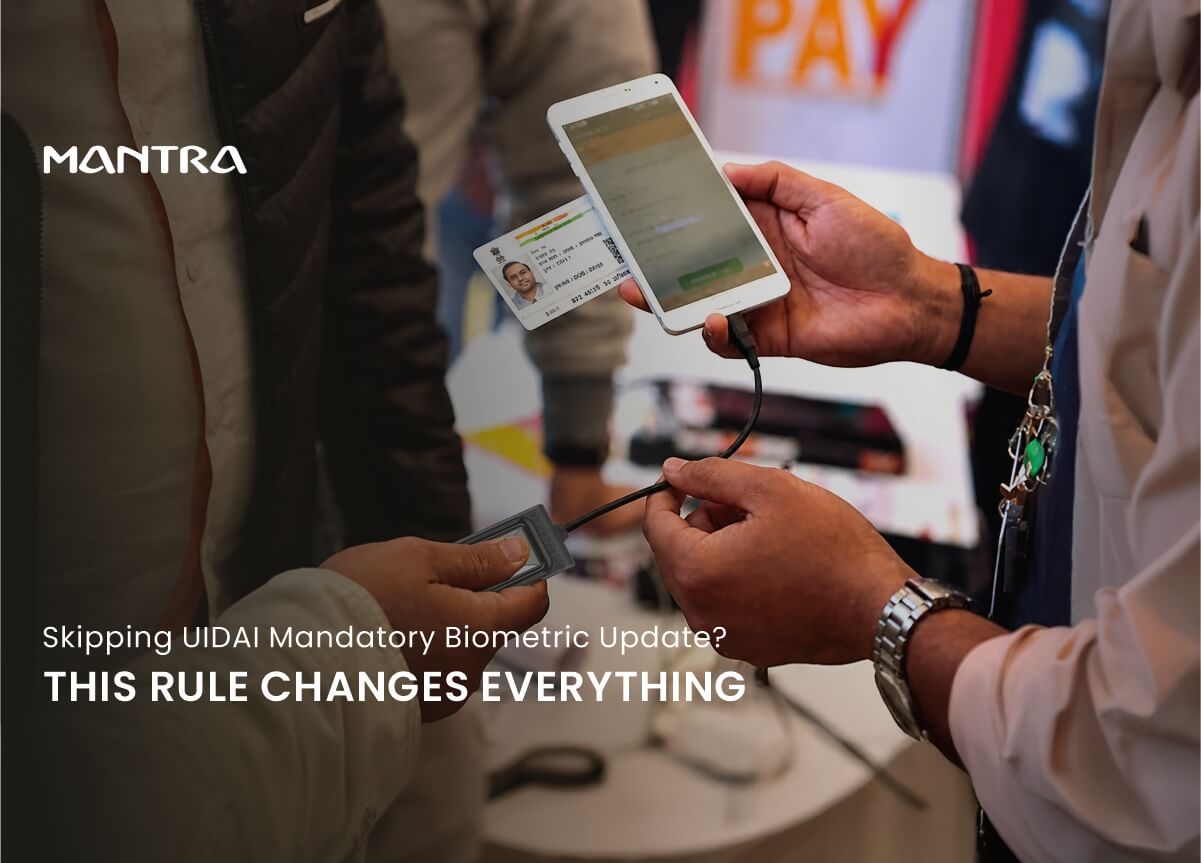
Skipping UIDAI Mandatory Biometric Update? This Rule Changes Everything
When a child is enrolled in Aadhaar below the age of five, only their photograph and basic demographic details i.e. name, date of birth, gender, and address are recorded. Fingerprints and iris scans are deliberately not captured at that stage, because biometric data in young children is not yet physiologically stable enough to be useful for de-duplication or authentication.
This is what UIDAI calls the Mandatory Biometric Update.
The first update, referred to as MBU-1, is required when the child turns five years old. At that point, fingerprints, both iris scans, and an updated photograph are recorded. The process runs as a fresh enrolment against UIDAI's de-duplication system for identity management, while the original Aadhaar card number remains unchanged.
The second update, MBU-2, is required when the Aadhaar holder turns fifteen, to ensure that the stored biometric data reflects matured adult biometrics. Both updates are treated separately, and both carry fee implications that parents often misunderstand until they actually arrive at a centre.
What Changed in October 2025
The cost question is where most confusion originates, because the rules have a grace window built in that not everyone is aware of.
Both MBU-1 and MBU-2 were free of charge, but only when completed within specific age windows: between five and seven years for the first update, and between fifteen and seventeen years for the second. Families who missed those windows were required to pay ₹125 per update. That fee was modest, but the harder problem was the number of families who simply did not know the window existed until it had already closed.
In October 2025, UIDAI made a significant policy change. All charges for mandatory l1 biometric device updates for children aged five to seventeen were waived until October 2026, regardless of whether the update falls inside or outside the original age window. The decision is expected to benefit approximately six crore children across the country.
The practical effect is that for the duration of that waiver, the ₹125 fee no longer applies anywhere within the 5-17 age bracket.
This is where it is worth being precise about the terms people search for. A mandatory biometric update, under UIDAI's framework, refers specifically to these two age-triggered events for children. It is not the same as a voluntary biometric correction that an adult might request if their fingerprints have degraded perhaps due to manual labour, aging, or medical conditions.
Adults can request a biometric update at any authorised centre, but that is a discretionary request, not a mandated one, and the fee rules are different.
Hardware Requirements at Enrolment Centres
Biometric updates cannot be done online. UIDAI permits only demographic updates through online channels; fingerprint, iris, and photograph updates are exclusively done in person at authorised Aadhaar Seva Kendras or enrolment centres embedded within banks, post offices, and government offices.
Biometric devices and operator verification are mandatory for accurate capture. Attempting to complete a biometric update remotely through any third-party app or website falls outside the authorised process.
The devices used at these centres are not generic scanners. UIDAI mandates that only STQC Registered Devices i.e. those formally registered with the authority and carrying a unique identifier may be used in the Aadhaar authentication ecosystem. These devices digitally sign the captured biometric data using a device provider's key, ensuring the data is live-captured and not replayed or tampered with.
Registered Devices fall into two categories. Discrete devices are external scanners connected to a host machine such as a laptop or PC. Integrated devices have the sensor built directly into the device unit, functioning independently. Both types must carry valid certification.
In 2022, UIDAI introduced L1 Fingerprint Registered Devices, aligning with international standards for hardware-level encryption. In 2025, two further upgrades came into effect: Fake Finger Detection (FFD) was implemented across L1 fingerprint devices to prevent anti-spoofing attempts, and L1 Iris Registered Devices were introduced for the first time.
The shift to L1 iris certification is significant as it brings iris capture under the same hardware security architecture that fingerprint devices have operated under since 2022.
The single most useful thing families can do right now is use the active fee waiver. With charges suspended for the entire 5-17 age group through October 2026, the cost barrier that previously delayed many MBU-1 and MBU-2 completions has been removed. After that window closes, the standard fee structure returns, and the age window logic applies again.
Comments