Key Points
Launching UPI Payments Without PIN But with Biometrics
Since Unified Payments Interface (UPI) became part of everyday payments, the checkout routine has remained familiar: scan a QR code, enter the amount, type in a UPI PIN and wait for confirmation.
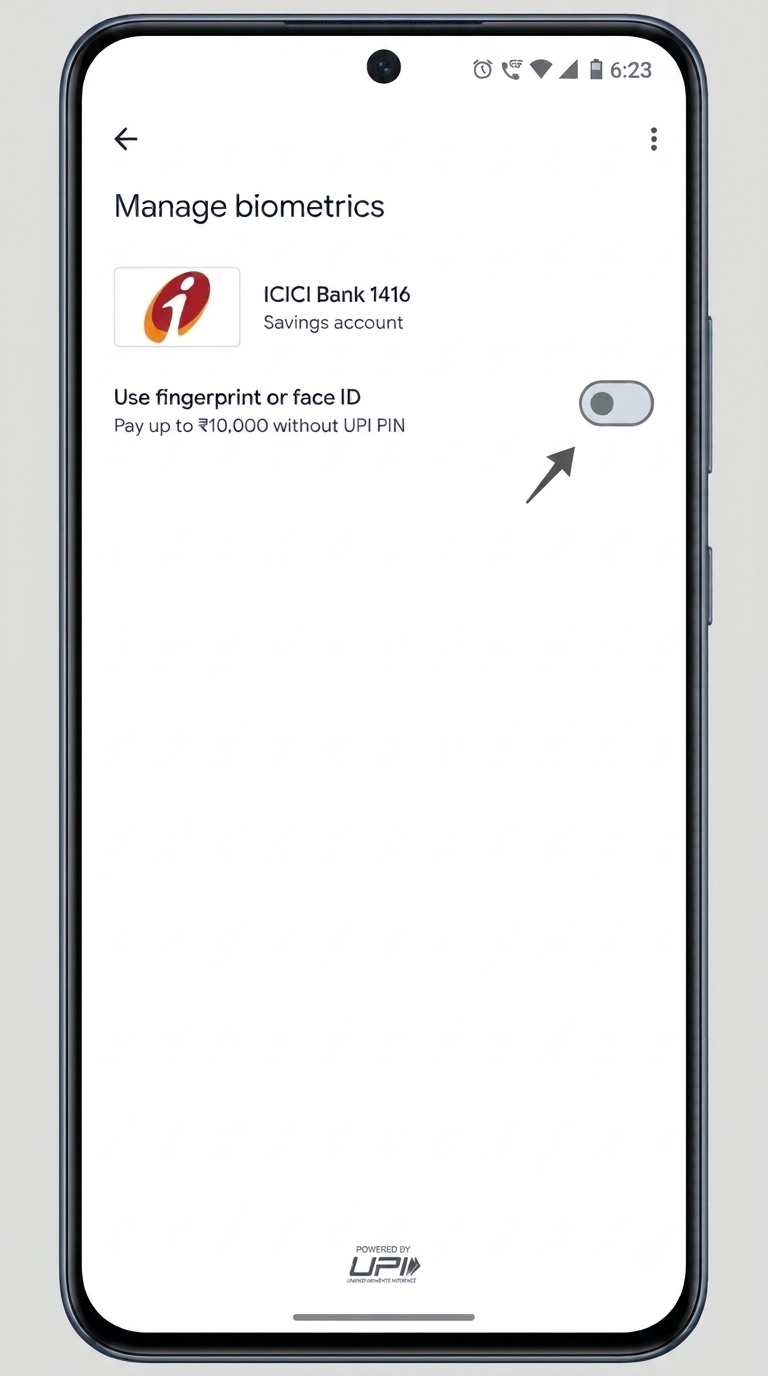
That routine now has an alternative. UPI biometric authentication lets eligible users approve payments with their phone's fingerprint or face recognition instead of manually entering the UPI PIN. The per-transaction limit, initially set at ₹5,000, increased to ₹10,000 from 7 August 2026. The feature remains optional, and customers can continue using their PIN.
For customers, this means fewer PIN entries at the checkout counter. For banks, payment service providers and app developers, it introduces another authentication method with specific consent, device-security and transaction-verification requirements.
NPCI Introduced Two Separate Biometric Features For UPI
On 7 October 2025, the National Payments Corporation of India (NPCI) issued Circular NPCI/UPI/OC-226/2025-26, introducing two additional authentication options.
They address different parts of the UPI experience.
Aadhaar Face Authentication for setting or resetting a UPI PIN
Users traditionally set or reset a UPI PIN using debit card credentials or Aadhaar One-Time Password (OTP) authentication. NPCI introduced UIDAI Face Authentication as another option. It allows an eligible user to verify their identity through a live face scan linked to their Aadhaar record and then set or reset the UPI PIN.
The process uses the Unique Identification Authority of India's (UIDAI) FaceRD application as part of the authentication workflow. The UPI application initiates the process, and the face authentication request is handled through UIDAI's system. This is particularly useful for users who do not have their debit card details available or prefer not to use the Aadhaar OTP route.
On-device biometrics for approving UPI payments
The second feature changes how users approve eligible transactions.
After scanning a merchant's QR code and entering the payment amount, an enabled UPI app can prompt the user to authenticate with the phone's built-in fingerprint or face recognition. The phone checks the biometric against the information enrolled on that device. The user does not need to type the UPI PIN for that eligible transaction.
The initial limit was ₹5,000 per transaction. NPCI subsequently raised it to ₹10,000, effective 7 August 2026. The UPI PIN remains available for payments above the biometric limit and for users who prefer the existing method.
The feature is not automatically available to every UPI user. The issuing bank, payment service provider and UPI application must support the implementation. Users must also meet the eligibility and device-security checks before enabling it. The original NPCI circular makes the optional nature of the feature clear. Customers can continue using their existing authentication method and can opt out of biometric approval.
Source: NPCI Circular OC-226. The revised ₹10,000 ceiling is attributed to NPCI Circular OC-226A, dated 3 July 2026, effective 7 August 2026. The original circular is publicly accessible; obtain the later circular from NPCI or a participating bank for direct verification before publication.
UPI Apps Must Obtain Consent and Validate the Device
NPCI's October 2025 circular sets out operational controls for banks, payment service providers and UPI applications. Before enabling on-device biometric authentication, the participating entities must:
These controls matter because biometric payment approval is linked to a particular user account and device. A change in device binding or UPI PIN requires the system to re-establish the user's consent and authentication status.
Liveness Detection Still Depends on the Device
Biometric security also varies across smartphones.
Some devices use additional hardware and software checks to distinguish a genuine biometric presentation from a photograph, recording or artificial sample. Others rely on different sensor and operating-system security mechanisms.
There is no single liveness-detection capability that can be assumed across every smartphone. Users and payment providers should check the security features supported by the actual device rather than assume that every face scanner uses depth or thermal sensing.
The phone's biometric feature is one part of the payment security process. Device binding, app security, bank-side verification and user consent remain important.
Comments