The evolution of home security has moved rapidly from brass keys to PIN pads, and now, to biometric access. A fingerprint door lock is a sophisticated piece of commercial-grade access control technology adapted for residential use. However, beneath the sleek metal housing and touchscreen displays lies a complex ecosystem of microcontrollers, biometric sensors, and cryptographic algorithms.
What Is a Fingerprint Door Lock?
A fingerprint door lock is an electromechanical access control system that uses a biometric scanner to verify a user's identity before physically retracting a deadbolt or latch. It replaces the physical keyway (the shear line and pin tumblers) with a digital verification process, eliminating the risk of lost, stolen, or duplicated keys.
While PINs can be guessed or shoulder-surfed, and RFID fobs can be cloned or handed to unauthorized users, a biometric lock requires the physical presence of the authorized individual. It binds the credential to the user, not to an object making it better in detecting a spoof.
How a Fingerprint Door Lock Works
When you touch a fingerprint door lock, a highly coordinated sequence executes in roughly 0.5 seconds. Based on modern IoT lock architectures (such as those utilizing ESP32 microcontrollers paired with biometric modules), the workflow is as follows:
The sensor takes a reading of your finger's topography.
The onboard processor identifies specific mathematical landmarks (minutiae points) on the print. The lock verifies if the presented finger matches a specifically claimed identity.
The lock converts these landmarks into a binary mathematical string and searches its entire Template Database to see if the presented finger matches any enrolled user.
The microcontroller's algorithm compares this temporary string against the enrolled templates stored in its local flash memory.
If the match score exceeds a predefined security threshold, the microcontroller sends an electrical signal to a relay switch. This allows battery current to power a motorized solenoid actuator, physically withdrawing the deadbolt.
The fresh scan is never a 100% perfect mathematical match to the enrolled template. The lock calculates a Match Score. If the score is higher than the manufacturer's Match Threshold, the door opens.
Security Metrics Most Buyers Never See
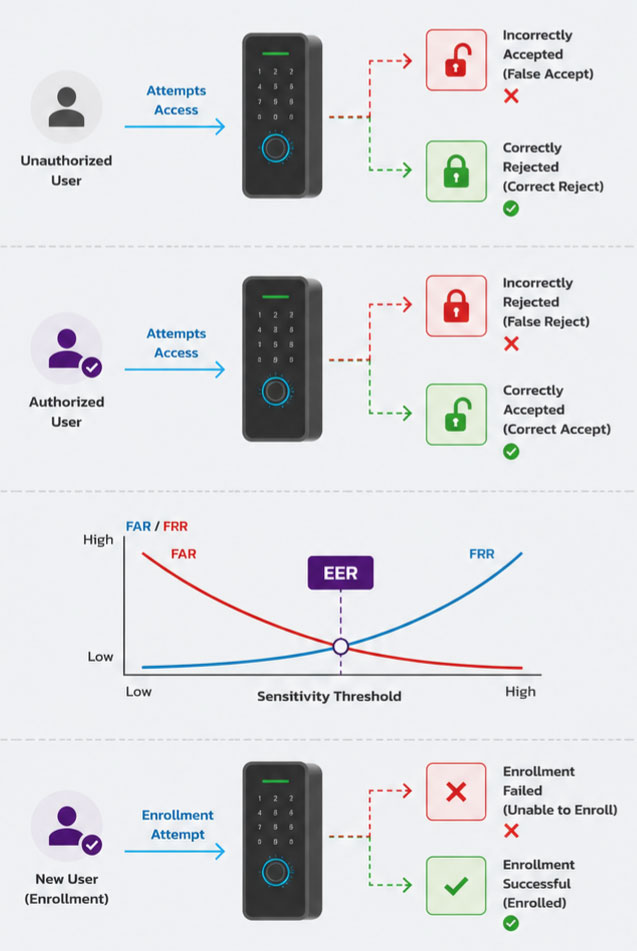
When evaluating a fingerprint door lock for high-security applications, professionals ignore marketing claims like "0.3-second unlock speed" and instead rely on standardized error rate PAD benchmarks:
FAR (False Acceptance Rate):
The probability that the lock grants access to an unauthorized person. While optical sensors often struggle to maintain this under spoofing conditions, capacitive and multispectral sensors easily exceed it.
FRR (False Rejection Rate):
The probability that the lock denies access to an enrolled, authorized user. Typically, acceptable around 1% to 3% to maintain a low FAR.
EER (Equal Error Rate):
The point where FAR and FRR intersect. The lower the EER, the more accurate the biometric system.
Failure-to-Enroll Rate (FTE):
The percentage of people whose fingerprints cannot be successfully read by the system.
Genuine security manufacturers publish their FAR and FRR figures publicly on their spec sheets. Most generic consumer brands on Amazon do not. The refusal to publish biometric error rates is itself a negative authority signal.
The ISO/IEC 19795 standard recommends an FAR of < 0.001% (1 in 100,000) for access control applications.
Fingerprint Door Lock Security Is Getting More Tougher
We are seeing a rapid shift toward the Matter protocol, which allows smart locks to communicate locally and securely over Thread without relying on vulnerable cloud servers.
Additionally, the adoption of FIDO Device Onboard (FDO) is emerging as the new standard for IoT device provisioning and participate more towards liveness detection for face door locks. FDO ensures that when a biometric lock is first powered on and connected to a network, the cryptographic keys are exchanged in a highly secure, automated manner that prevents man-in-the-middle attacks.
As these protocols mature, the biometric door lock will transform from a standalone gadget into a fully encrypted node within a Zero Trust home network.
Biswajit Barman
This is a very informative guide to fingerprint door lock security. I particularly appreciate the explanation of FAR, FRR, EER, and liveness detection, as these technical security metrics are often overlooked when people compare biometric locks. The discussion around encrypted local biometric templates and emerging standards such as Matter also provides useful context for understanding where smart access control is heading. A helpful resource for anyone evaluating fingerprint-based door security.
Reply