Today, the future of airport parking relies on intelligence. Newly launched hubs in 2026, such as India's Noida International Airport and Abu Dhabi's Zayed International, treat parking as the first touchpoint of a completely frictionless, AI-driven journey.
To keep traffic moving without compromising security, major airports including GMR-run hubs in India build what the industry calls a Parking Access and Revenue Control System (PARCS): a platform that centralizes access, payments, enforcement, and analytics into a single source of truth for occupancy and transactions.
At the heart of most modern airport PARCS deployments sit two sensing technologies working in tandem such as Radio Frequency Identification (RFID) and Automatic Number Plate Recognition (ANPR).
Both identify a vehicle in milliseconds. But they "see" different things. One tracks a tag; the other tracks a car. Airports that rely on only one invite congestion or fraud. Here is how they work together, and what's actually happening under the hood.
RFID
Airport-grade RFID tags run on the EPCglobal Class 1 Generation 2 (Gen2) air-interface protocol, standardized as ISO/IEC 18000-63, operating in the 860-960 MHz UHF band.
One reason gate readers don't choke during a post-landing surge of cars is Gen2's anti-collision mechanism which is a dynamic algorithm that lets a single reader identify multiple tags moving through its field simultaneously, rather than queuing them one at a time.
That's what makes multi-lane, non-stop RFID gates viable during flight-wave traffic instead of a single-file bottleneck.
ANPR
ANPR uses high-speed cameras and optical character recognition (OCR) to turn a license plate image into searchable text.
It captures a timestamped photograph of the vehicle and requires no hardware on the car, making it the natural net for one-time visitors and guests who will never own a tag.
While RFID and ANPR act as the eyes of the parking gate, the brain behind them has evolved. Modern PARCS deploy high-end software to process the data these sensors collect.
Common technologies standard in modern airports now include:
-
Digital Wallets & FASTag Integration:
In major Indian hubs run by GMR (Delhi, Hyderabad, Goa) and the newly launched Noida International Airport, RFID acts as a direct link to a user's FASTag wallet. Meanwhile, Abu Dhabi's Zayed International uses ANPR to automatically deduct fees from digital wallets (like Darb), removing payment kiosks entirely.
-
Video Parking Guidance Systems (VPGS):
Once ANPR/RFID lets a car in, overhead AI cameras take over, guiding the driver to an available space via LED signage. This eliminates the dreaded "airport circle" and cuts emissions.
-
Dynamic Pricing:
Taking a cue from airlines, AI parking systems now analyze booking data to adjust parking rates based on real-time demand, maximizing capacity during flight-wave surges.
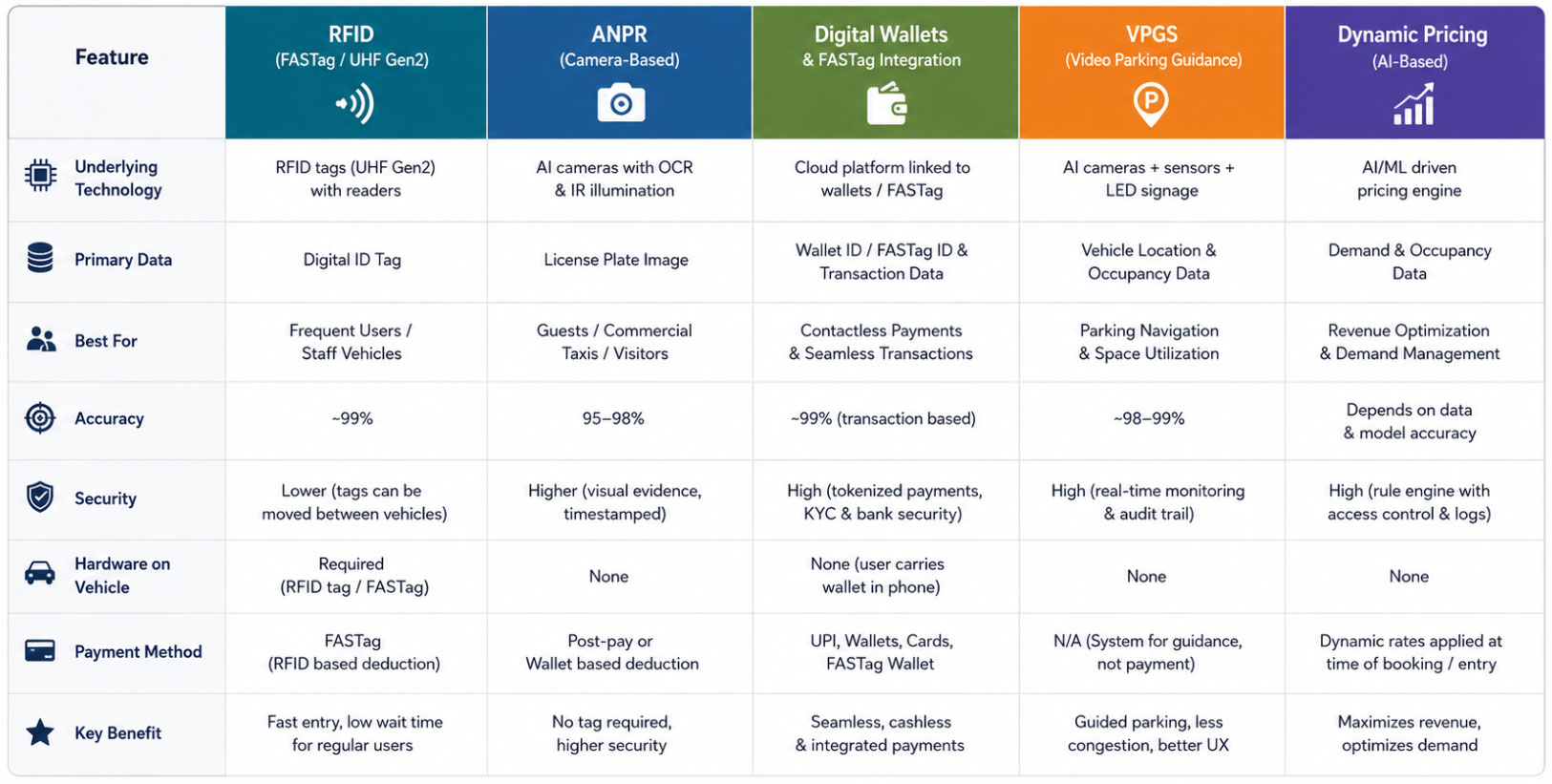
Comparison Table for RFID vs. ANPR and Beyond.
How the Two Works Together in an Airport?
In a well-built PARCS, the two sensors cross-check each other in sequence:
-
RFID pre-read.
As a vehicle approaches, the UHF reader picks up the tag ID from several meters out and pulls the associated vehicle record from the backend database.
-
ANPR confirmation.
As the vehicle crosses the gate line, the camera captures and OCRs the plate.
-
Mismatch flag.
The system compares the plate on file for that tag ID against the plate ANPR just read. A match opens the barrier silently. A mismatch which might be a swapped tag, a cloned tag, or a plate that doesn't correspond to any registered tag as it triggers a business rule: hold the barrier, alert security, or route the vehicle to a manual lane.
-
Fallback routing.
If one sensor fails to read like a smudged plate, RF interference from nearby equipment and the other one carries the transaction, so the gate doesn't default to fully manual processing.
This sequencing is the actual mechanism behind "stopping revenue leakage." It's not two systems watching redundantly; it's one system using the second sensor as both an integrity check and a failover path.
Why Hybrid Systems Win
Beyond catching tag-swap fraud, the RFID/ANPR pairing protects uptime. If the camera can't get a clean read on a mud-streaked plate, RFID authenticates the vehicle instead; if a tag fails to fire, ANPR fills the gap.
In municipal and commercial PARCS deployments, this pairing typically recovers 10-20% of previously missed revenue and speeds up lane throughput by 15-30% (project-dependent).
An airport gate is a funnel for diverse users. RFID clears "the regulars" through dedicated lanes at highway speed. Simultaneously, ANPR logs "the guests" without forcing them to buy or register a tag for a twenty-minute drop-off.
Security teams cannot interrogate a radio signal. ANPR provides what RFID cannot: visual proof. When a dispute arises or a watchlist alert triggers, the system produces a timestamped photo of the vehicle, the driver, and the plate which is an evidence an RF tag ID alone can never supply.
A perfect example of this hybrid system at work is the kerbside management at newly opened hubs like Noida International Airport (Jewar). To prevent terminal gridlock, the airport grants an 8-minute free drop-off window.
By utilizing a hybrid network of ANPR and RFID, the system precisely timestamps a vehicle's entry and exit. If a car idles on the kerbside for 9 minutes, the system immediately flags the delay and automatically bills the user's wallet. It completely automates congestion control.
The Bottom Line
RFID and ANPR answer the same question with different evidence. One reads what is attached to the vehicle; the other reads the vehicle itself. Run independently, each has a blind spot. When run together, airports transform a bottlenecked gate into a smart checkpoint that secures revenue and speeds up the journey.
Comments